

Ullukkut. Janna MacLachlanngujunga; pigartulirijiujunga. [Inuktitut to English translation: Hello. My name is Janna MacLachlan. I am someone who helps someone who has difficulty (pigartuliriji is a term commonly used for occupational therapist)]. This is how I would commonly introduce myself in my occupational therapy practice in Nunavut. (Note: An earlier version of this story appeared in the author’s doctoral dissertation.33)
Early in my doctoral studies, I met an occupational therapist at a professional event who asked about my research. I shared that I was interested in helping to improve rehabilitation services offered to Indigenous communities in Northern Canada. She responded, “Oh, there’s so much opportunity for OT up there, isn’t there?” I said, with a bit of an annoyed tone, “Actually, sometimes I think OT needs to get out of the way.” She appeared to be taken aback by my comment, but at that very moment the event started and our conversation was cut short. I felt bad that I didn’t have a chance to explain where I was coming from. But I’ll explain it now to you, the reader. More importantly, I will share what I’ve learned since then and consider the kind of response I hope to verbalize in the future. The story I offer here is a snapshot of one thread of my ongoing learning journey about my place, and the place of OT in reconciliation in Canada.
I am a White woman of settler descent who grew up in rural Mi’kma’ki. I studied to become an occupational therapist in southwestern Ontario and graduated in 2006. With an interest in being a generalist and wanting to experience a new part of Canada, I took a job in Nunavut, one of Canada’s northern territories. As noted by Nunavut Tunngavik Incorporated, Nunavut’s formation was the result of Canada’s largest Indigenous land claim, providing Inuit with the opportunity to govern a large part of their homeland.34 Beyond this and the little I had gleaned from high school and undergraduate social studies and history classes, I knew close to nothing about the People I would be working with.
And so, I started practicing, somewhat naively, following the norms and approaches I had learned in Ontario. I took a beginner Inuktitut language class and there were occasional work-sanctioned education days when we would get to go on the land and learn about Inuit culture. However, it didn’t seem that this learning ever penetrated healthcare practices. Even from my early days working in Nunavut, I felt that my services weren’t quite on the mark with what many Inuit, especially families with young children, were looking for.
After 10 years of periodically working in Nunavut, I began my doctoral studies at the University of Toronto, seeking to interrogate these gut feelings and learn about ways to do better. I took courses in Indigenous research methods and critical social theory. I began learning about healthcare’s White, Eurocentric norms and how harmful they can be for Indigenous people seeking care. I began reflecting on how the Government of Nunavut expected all its services to be informed by Inuit Societal Values and Inuit Qaujimajatuqangit (the Inuit worldview), but I couldn’t say if or how any aspect of my practice had aligned with them. I didn’t know; I’d never asked. I learned about Indigenous rights, including self-determination, which, among other things, involves Indigenous Peoples being able to shape the systems that serve their communities.35
I also learned of a resource developed by Inuit Elders and the local health research center about parenting from Inuit perspectives (Qaujigiartiit Health Research Centre36). This resource included tips for parents on supporting development for children at different ages. It was a far cry from the standardized developmental assessments I had been doing with Inuit children for years. I felt frustrated that I spent so much time counting how many blocks a child could stack when I hadn’t asked parents about the child’s relationship to the land or the community.
It was clear that my Western lens had a different focus from that of many Inuit I worked with. It was amid this learning that I attended the professional event where I tersely suggested to a colleague that we occupational therapists need to get out of the way. Her comment had struck me as White saviourism and classic settler colonialism: a population with relative power assuming they could move in and find “opportunities.” But my learning was not (and will never be) finished.
From there I went on to complete my dissertation research where I met with Inuit to discuss how rehabilitation services should be offered to Inuit children. I went in essentially open to burning the whole thing down. Except no one handed me a match. None of the participants, despite having witnessed colonialism on their lands in innumerable forms for their whole lives, said “less OT, please.” In fact, participants expressed that they want more OT, but a more relevant OT: one that’s welcoming, grounded in Inuit values, and provided in Inuktitut. I learned it wasn’t OT that needed to get out of the way, but the Western worldview and power that guided it.33 It’s a nuanced but essential distinction. I am hoping that the guidance provided by study participants can help to evolve rehabilitation services offered in Nunavut to be more contextually relevant.
There is much work to be done, not the least of which is having more Inuit occupational therapists. I can study Inuktitut and learn everything I can about Inuit Qaujimajatuqangit, but I will never be Inuk. (Inuk [person] is the singular form of Inuit [people] in Inuktitut.) Therefore, I will never be able to fully represent the Inuit worldview in my practice.33 But I still can do better, and I’ve sensed changes in my school-based practice as I’ve learned and grown over the course of my research.
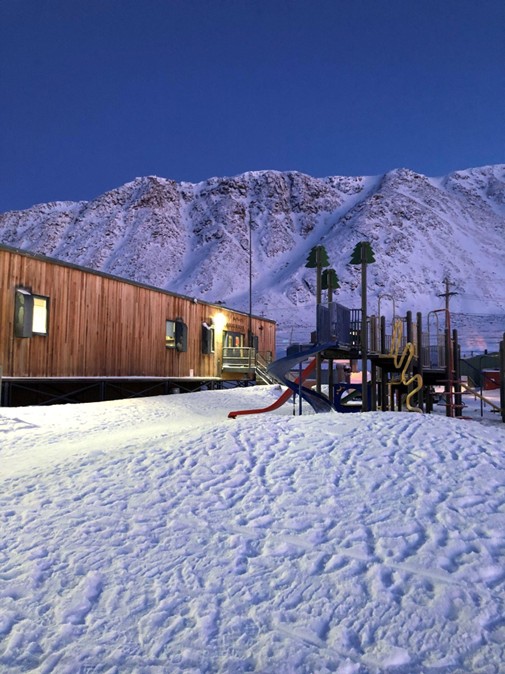
Note. Image shows a school and playground equipment, with mountains in the background. The ground and mountains are covered with snow. The photo was taken at midday during the dark season of winter when the sun doesn’t come above the horizon, making the photo appear to be taken at night. Photo captured by Janna MacLachlan at Grise Fiord, Nunavut, in January 2021.
One change I have implemented in my practice is to put more emphasis on relationships. Relationship-based care is advocated by many Indigenous groups as being aligned with Indigenous worldviews.37,38 As a White stranger entering communities where people have witnessed many harmful policies and practices enforced by White strangers, including child apprehension, forced displacement for medical treatment, and slaughtering of sled dogs,2,39 I recognize that it is my responsibility to get to know people and not presume to know what will benefit them. I am also learning about what it means to actually be holistic and strengths-based in my practice.
Spoiler alert: this doesn’t include categorizing children into standardized percentiles. Through my research project, I learned that Inuit might approach supporting child development in terms of what a child is ready to work on next rather than thinking about catching them up to a socially-constructed “norm” defined by people living thousands of kilometers from Nunavut. Participants emphasized that every child has something to offer their community, no matter what their abilities are.33
Our intervention will be the same whether we start with what a child is ready to work on, or start at a point X degrees from a “norm.” We just skip the part where we tell them how un-normal they are. I began to wonder why we assume that tools developed in one cultural context should be valid everywhere.
Our neoliberal systems of productivity would have us efficiently assess and discharge clients on a factory conveyor belt. But if we don’t have relationships and see only what we think we need to fix, we have nothing. I was once at a team meeting at a school where a new colleague exclusively reported on a child’s developmental assessment scores and informed teachers of what they urgently needed to do to address the child’s delay. The therapist spoke as though her expert view (from a few hours with the child) held authority, dismissing the perspectives of the teachers (who worked with the child every day). The teachers and I were angry and hurt by the therapist’s approach that lacked any spark of the smart and fun youngster we knew. It lacked acknowledgement of all the wonderful things the teachers were doing and the progress the child had made. A strengths-based approach would have been culturally relevant, and beyond that, more respectful.40
This brings me to another lesson we might take from my learning about reconciling how I practice OT in Inuit communities: the shifts I’m learning to make in my practice might also be appreciated by other people in other places.
The changes I’m learning to make, to offer a better OT service to Inuit, are both minimal and profound. I still draw on the OT knowledge base, but prioritize Inuit- and contextually-relevant sources, and aim to start from an entirely different point of departure and weighting of priorities in my practice. When I orient according to strengths and start with a priority on relationships, I still focus on occupation, I’m still an occupational therapist, but I end up with a very different result.
I remain open to OT in Nunavut having a different shape, different borders, and a different ontology and epistemology than OT in other contexts. OT in Nunavut can’t and shouldn’t fit into the boxes prescribed by the neoliberal, Eurocentric status quo. To resist this will take effort. The work of decolonizing OT in Canada has hardly gotten started, from my perspective.
I’m still learning what I need to do, even as I act to do better. I don’t have answers; I can only share my experiences and lessons learned. What could I say to occupational therapists I meet at future professional events? My mind turns to the concept of relational accountability, an important feature of Inuit epistemology (as described in Healey and Tagak41). What can I say that is accountable to the relationships I have with Nunavummiut (people of Nunavut)? How can I affirm the strengths of Nunavut and Inuit, and not just reinforce the usual narrative about Indigenous communities in Canada that is so focused on deficits?
In moments when my mile-a-minute-Western-trained brain is present enough to be attuned to it, I have observed Inuit Elders model humility, empathy, and reciprocity in their answers to questions. What can I learn from this that might help me frame a different, and more helpful, response? Maybe, I could say that I believe there’s a lot of opportunity for occupational therapists to learn and support the building of a contextually-relevant OT as directed by Inuit.

This work is licensed under a Creative Commons Attribution 4.0 International License.