Research Question:
How are individuals with spinal cord injuries (SCI) who are both caregivers and care receivers represented within health and rehabilitation scholarship?
Abstract
Background.
Research on spinal cord injury (SCI) has historically focused on individuals with SCI as care recipients rather than caregivers. Yet many people with SCI simultaneously provide and receive care, challenging a binary understanding of dependence and autonomy.
Objective.
This study examined how individuals with SCI who are caregivers are represented within health and rehabilitation scholarship and explored the recurring patterns and assumptions that shape these representations.
Method.
A critical literature review examined 13 peer-reviewed studies published between 1980 and 2021 and identified through a PubMed search. Guided by Critical Disability Studies, the analysis examined how caregiving, disability, independence, and interdependence were constructed within health and rehabilitation scholarship.
Results.
Across four decades of literature, overt deficit-based representations of caregivers with SCI gradually gave way to narratives emphasizing resilience, adaptation, and capability. However, many studies continued to privilege independence and able-bodied norms, limiting how caregiving and interdependence were understood within health and rehabilitation scholarship.
Conclusion.
This study highlights the importance of moving beyond binary understandings of dependence and independence in caregiving research. Reframing caregiving as an interdependent and relational process may help inform more inclusive health and rehabilitation research, policy, and practice that better reflect the lived realities of caregivers with SCI.
Key Words: Critical Disability Studies (CDS); spinal cord injury (SCI);caregiving; interdependence; Critical Literature Review
Background and Introduction
Over recent decades, disability scholarship has increasingly challenged deficit-based understandings of impairment and adopted approaches that foreground lived experience, embodiment, and social context, challenging medicalized notions that equate normalcy with productivity and independence.1-5 Critical Disability Studies (CDS) extends this shift by examining how institutions and cultural values construct disability, and by reframing care through interdependence rather than individual independence.6-9
While CDS provides a foundation for examining how structural power shapes disability, it also invites a deeper examination of how care is defined. People with spinal cord injury (SCI) offer an important case for examining care beyond binaries that separate caregivers from care receivers. Much of the scholarly literature on SCI research emphasizes burden and strain, positioning people with SCI mainly as care recipients and obscuring the reciprocal nature of care.10-11
Studies on parents with SCI highlight creativity and resilience while also suggesting that able-bodied norms still define “good” parenting for people with SCI.12-13 In there systematic review of parenting among mothers and fathers with SCI, Brennan and Swords12 identified resilience but notes that most empirical work continues to benchmark these parents against able-bodied norms. Such work reproduces narrow ideas about ability and family life, offering limited insight into how people with SCI actively provide care while also receiving it.
Critical and post-structural approaches to SCI research have emerged to interrogate such assumptions directly. Sakellariou14 examined “care of the self” as a practice of agency and resistance, while Bryant and colleagues15 employed critical discourse analysis to study how sexuality support is constructed in rehabilitation settings. Their work demonstrates how critical discourse analysis can explain the ideological dimensions of professional and academic language.
Building on these insights, our study uses a critical literature review informed by CDS to analyze how people with SCI who are also caregivers are represented within health and rehabilitation scholarship. Specifically, we analyze how narratives of deficit, resilience, and adaptation appear across the literature and how these representations may have shifted over time. Through this analysis, we aim to contribute to ongoing efforts within disability scholarship and health and rehabilitation practice to move beyond binary notions of dependence and independence and to foreground the realities of interdependence that underpin human care.
Theoretical Underpinnings
This article is grounded in CDS, an interdisciplinary field that examines how power, ideology, and social structures shape the meanings and lived experiences of disability.6-7,16 CDS views disability as a social and political construct, revealing how everyday practices, policies, and research norms determine who is considered “able” and who is not. It highlights how cultural values such as autonomy, productivity, and normalcy privilege certain bodies and ways of being while marginalizing others.3-4
CDS challenges ableist norms that classify bodies as “able” or “disabled” based on perceived usefulness or conformity to societal ideals.1,7 As Shildrick17 notes, those labeled “disabled” are often constructed as less capable of work, parenting, or social contribution. Goodley3 further argues that ableist assumptions may position disabled people as dependent or burdensome, reinforcing deficit-based understandings of disability.
In this study, CDS provides a lens for examining how caregivers with SCI are represented in health and rehabilitation scholarship. It supports a critical examination of how caregiving, competence, independence, and support are framed within health and rehabilitation scholarship. CDS also situates disability within systems of power and inequity, emphasizing intersections with gender, class, race, and colonial histories.16,18
Methods
This qualitative study used a critical literature review approach to examine how caregivers with SCI are represented within health and rehabilitation scholarship. Guided by CDS, the analysis focused on how caregiving, disability, independence, and support were described across the reviewed literature. Attention was given to the assumptions, values, and normative ideas reflected within the literature.19-20 Together, these approaches enabled the research team to explore how health and rehabilitation knowledge shapes dominant understandings of care, independence, and capability. The research team included a master’s candidate, a postdoctoral fellow, and a project manager. Each team member contributed to the design, data collection, and analysis.
Search Strategy and Data Sources
A set of key terms was generated to capture variations in terminology related to SCI and caregiving. These terms included: “spinal cord injury,” “SCI,” “caregiver,” “caregiving,” “parent,” and “parenting.” Keywords were intentionally combined to locate studies that addressed both spinal cord injury and caregiving within the same article. Boolean operators (AND, OR) were used to ensure relevant overlap between terms related to SCI and caregiving.
PubMed was selected for its comprehensive coverage of health, rehabilitation, and biomedical research, including journals on spinal cord injury and caregiving. Its interdisciplinary scope across rehabilitation, nursing, and allied health provided a strong foundation for analyzing caregiving in health and rehabilitation scholarship. Using a single curated database supported a focused and replicable search consistent with the study’s qualitative design.
To keep the results manageable and focused, we applied three clear limits:
- Publication Dates: Studies published between 1980 and 2021, to track historical and contemporary scholarly literature.
- Language: Articles written in English only.
- Article Type: Full-text, peer-reviewed empirical studies.
As this study analyzed publicly available, peer-reviewed literature and did not involve human participants, formal research ethics approval was not required.
The search was completed in 2021 and was designed to examine how health and rehabilitation scholarship about caregivers with SCI may have shifted across four decades. This endpoint captured the most recent literature available at the time of data collection and analysis. Post-2021 publications fell outside the scope of this review and warrants separate analysis.
Selection Process
The search and selection process occurred in three distinct stages to ensure rigor and transparency.
In the first stage, all search results were exported from PubMed into a Microsoft Excel spreadsheet for manual organization and screening. Excel was used to document article titles, abstracts, and decisions about inclusion or exclusion. Each title and abstract was reviewed to determine whether the study addressed spinal cord injury and caregiving.
To be included, studies needed to focus on individuals with SCI who engaged in caregiving or parenting roles. Articles that addressed other disabilities, paid caregiving, caregivers of people with SCI rather than people with SCI who provide care, or studies outside the scope of our question were excluded. The review focused specifically on unpaid caregiving within family and relational contexts to examine how informal care is constructed within health and rehabilitation scholarship. Paid caregiving involves distinct labor, economic, and regulatory frameworks that warrant separate analysis and was therefore outside the scope of this study.
In the second stage, we conducted a full-text review. The remaining articles were read in full to determine eligibility. Notes about eligibility decisions, publication year, and geographic location were recorded in Excel to support transparency and consistency.
The final stage involved reaching consensus and final selection.
The research team met to review all remaining articles collectively. Each team member compared notes recorded in the Microsoft Excel spreadsheet; any uncertainties about inclusion were discussed until consensus was reached. At the conclusion of this process, 13 studies met all inclusion criteria and were retained for analysis. (See Table 1.)
Of the 13 included studies, 3 were published between 1980 and 1999, 4 between 2000 and 2009, and 6 between 2010 and 2021. This distribution supported comparisons of discursive constructions across four decades of health and rehabilitation scholarship.
Critical Literature Review
We conducted a critical interpretive analysis of the 13 included studies to examine how caregiving and disability were represented within health and rehabilitation scholarship. This analysis was guided by CDS and focused on how assumptions related to caregiving, independence, competence, and support were reflected across the literature.19-20
The analysis was informed by Braun and Clarke’s21 approach to coding and pattern development and used coding as a systematic tool to organize textual data. Coding was used to identify recurring patterns in how caregiving, disability, dependence, independence, and competence were described across the literature. These patterns were then examined in relation to the assumptions, values, and normative ideas reflected within health and rehabilitation scholarship.
The analysis proceeded through seven iterative stages developed by the research team to support systematic coding and interpretation:
- Each article was read in full to examine how caregiving, disability, and family life were represented within health and rehabilitation scholarship.
- Passages referring to caregivers or parents with SCI were extracted verbatim into Excel, alongside publication year, journal context, and brief analytic memos.
- Recurring words, phrases, evaluative terms, and representational patterns such as burden, independence, adaptation, and normal were coded to examine how caregiving was framed within the literature.
- Codes were grouped into broader interpretive patterns related to caregiving, competence, dependence, independence, and support.
- Interpretive patterns were analyzed for the assumptions, binaries, and power relations they reproduced or disrupted, with particular attention to constructions of dependence and independence.
- Patterns across the literature were compared across decades to examine potential shifts in how caregivers with SCI were represented within academic knowledge production.
- Excel functioned as a structured audit trail, allowing the research team to trace analytic patterns and interpretations back to specific extracts, publication details, and historical context.
Positionality. As researchers, we recognize that our interpretations are shaped by our social location and academic training. This study draws on our work in health and rehabilitation sciences and Critical Disability Studies. As a parent of two young children and a caregiver, the first author draws on her lived experience to deepen her understanding of the barriers faced by disabled caregivers who provide and receive support within complex systems. Our collaborations with disabled community members and community partners inform how we read and interpret these texts. These experiences heightened our awareness of how language can reproduce assumptions about competence, dependency, and worth. We approach this work with an awareness that research is never neutral and that language carries power. Our analysis is informed by a commitment to examining deficit-based representations and exploring more inclusive understandings of caregivers with SCI.
Reflexivity and Trustworthiness. Reflexivity was embedded throughout the analytic process. Team members kept detailed notes and annotations during reading, coding, and interpretation to document reflections and emerging insights. An audit trail was maintained in Excel, including verbatim extracts, coding decisions, and notes on pattern development. Regular team meetings created opportunities to compare observations, challenge interpretations, and examine how positionality shaped analytic choices. Returning to extracts after periods of distance helped ensure that interpretations and analytic patterns remained grounded in the language of the studies. Transparent documentation of decisions from search to synthesis enhanced the credibility and trustworthiness of the study’s findings.
Results
Findings and Analysis
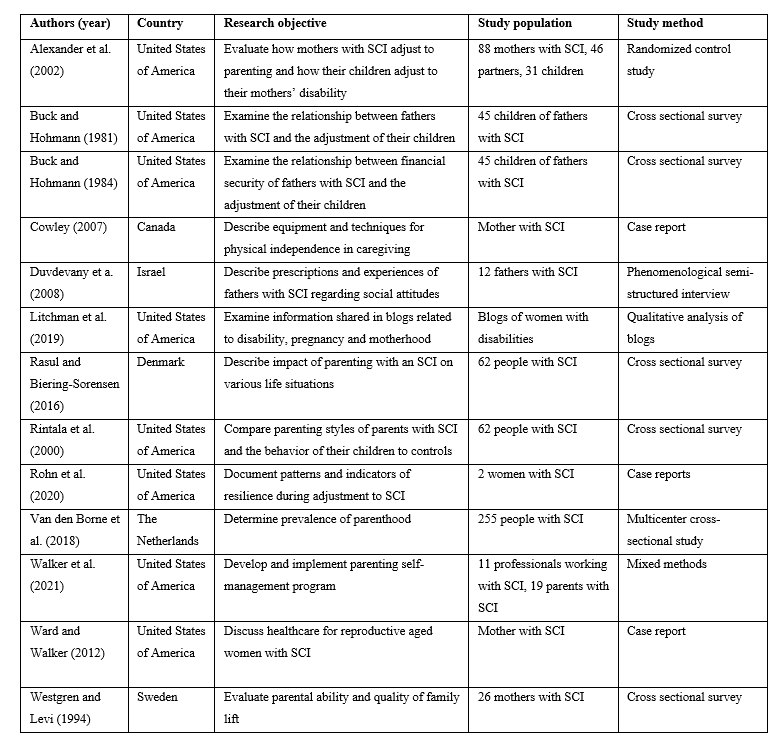
Six recurring patterns were identified across the 13 studies, revealing how caregiving, disability, and capability are represented within health and rehabilitation scholarship. Across the literature, assumptions related to independence, normalcy, burden, and competence were both reinforced and, at times, challenged.
Together, these patterns demonstrate how rehabilitation scholarship may reflect and reproduce broader social understandings of disability, caregiving, and dependence.
Theme 1: Shift in How Caregivers with SCI Are Viewed
In earlier studies reviewed, caregivers with SCI were portrayed negatively, often viewed as a burden or inherently incapable of fulfilling caregiving roles. This perspective reflects long-standing assumptions that disability limits one’s ability to provide care for dependents. Early work 1-23,24 positioned caregivers with SCI as sources of family strain, using language such as burden, difficulty, and deficit that frames disability as a problem to be managed rather than a relational difference within family life. Such language positions disability primarily within the individual rather than within broader social and structural contexts.
Over time, however, there has been a noticeable shift in how caregivers with SCI are represented within the literature, with more recent studies challenging this deficit-based narrative. Researchers now emphasize the strengths and strategies employed by caregivers with SCI. For instance, Rintala et al25 compare the parenting styles of individuals with and without SCI. Their findings highlight that parents with SCI can provide warmth and structure similarly to parents without disabilities. Here, a phrase such as “despite physical limitations” maintain a subtle hierarchy equating independence with competence. Capability is affirmed, but only through contrast with able-bodied norms.
Additionally, Rasul and Biering-Sørensen26 highlight both challenges and successes among caregivers with SCI, noting that many parents adapt effectively. However, success is frequently introduced through contrastive language such as, yet or however, implying achievement against adversity. This framing positions caregiving with SCI as exceptional rather than ordinary, reinforcing the idea that competence must be demonstrated rather than assumed.
Van den Borne et al27 emphasize the importance of external supports, such as medical aids and partnerships, in enabling caregivers with SCI to thrive. While this recognition of support expands the frame beyond individual limitation, it also ties capability to access to technology and professional systems. As a result, caregiving competence may continue to be understood through access to support systems rather than through broader relational understandings of care.
Finally, Westgren and Levi further underscore the ability of women with SCI to provide quality care, rejecting outdated assumptions about incompetence: “There is no reason to question females with an SCI in their roles as parents…”.28(p517) Even this affirmation must first deny doubt before asserting capacity, revealing how suspicion remains normalized in academic writing. The rhetorical structure begins from a position of doubt, demonstrating how deeply skepticism toward disabled caregiving remains embedded within health and rehabilitation scholarship.
Collectively, these studies show a gradual but partial shift from portraying caregivers with SCI as dependent to recognizing them as capable contributors. However, recurring qualifiers despite physical limitations,24 and no reason to question,28 reveal that independence still defines value, and the tension between independence and interdependence endures.
Caregiving with SCI is no longer framed as impossible, but it often remains framed as something that requires validation or proof.
Theme 2: Narrow Definition of Caregiver
Much of the existing research equates caregiving primarily with parental roles, overlooking other significant forms of caregiving that occur within families and communities. Consequently, less attention is given to caregiving shared among siblings, partners, grandparents, friends, and community members. Across the studies reviewed, caregiving is most often portrayed as a one-directional act of assistance rather than a reciprocal relationship. This reflects how health and rehabilitation research values task-based forms of care such as feeding, mobility, and daily living over relational or emotional support. Care is frequently operationalized through observable tasks rather than relational processes.
Duvdevany et al13 challenge this narrow focus, showing caregiving as a social process. Interviews with fathers depicted parenting as everyday practice and meaning-making, including open dialogue intended to “break down obstacles of ignorance” and “shape children’s attitudes towards difference.”13(p1031) Here care functions as knowledge exchange and emotional connection, exposing the limits of frameworks that define care primarily through physical performance.
Similarly, Rintala et al25 frame “good parenting” through standardized measures, comparing parents with SCI to able-bodied parents on warmth, strictness, and social competence. Although no significant differences were found, success was still defined as similarity to able-bodied norms. This positions caregiving as something to be proven rather than understood.
Cowley29 shows how assistive technology enables individuals with SCI to take on roles traditionally viewed as too physically demanding. While her findings expand what is considered possible, they also validate caregiving through performance and efficiency, sidelining relational forms of care that cannot be quantified. Rasul and Biering-Sørensen26 echo this pattern: in their national survey of parents with SCI, “success” is indexed using measurable independence.
Van den Borne et al27 further link caregiving to fertility and parenthood, showing that both males and females with SCI face reproductive barriers and that parenthood prevalence is treated as a participation metric. This biomedical framing equates care with biological reproduction, narrowing its social meaning to the nuclear family and reinforcing parenthood as the primary site of caregiving legitimacy.
Across these studies, caregiving is frequently represented through individualized and biomedical frameworks. Caregiving competence is often evaluated through independence, productivity, and measurable outcomes, while emotional reciprocity and collective care receive comparatively less attention. As a result, caregiving may continue to be understood primarily as an individual capacity rather than a shared and relational practice.
Theme 3: Gender Differences in Caregiving
The experience of caregiving is also shaped by gendered expectations and societal norms. Across the literature, gender operates as both a descriptive category and an implicit hierarchy, organizing how caregiving is framed. Female caregivers with SCI are often described through narratives of reproduction, risk, and emotional labor, while male caregivers are positioned through narratives of productivity, strength, and restoration of control.
Early studies focused on the capacity of fathers with SCI to maintain family stability. For example, Buck and Hohmann concluded that “children of fathers with SCI are well-adjusted … and regard their fathers highly.”22(p437) These findings reinforce traditional expectations of masculinity associated with leadership, protection, and productivity within family life.
When female caregivers appear, the narrative shifts from reassurance to risk. Alexander, Hwang, and Sipski write that “partners of spinal-injured mothers expressed more life stress than did partners of able-bodied mothers,”24(p28) constructing motherhood as a problem to be managed rather than a relationship redefined. Westgren and Levi challenge this by reporting that females with SCI “perfectly well meet the demands of parenthood” and live “a rich and in every way complete family life.” Yet, the very need for such defense reveals how normalized suspicion of disabled motherhood remains.28(p523) Biomedical logics reinforce these gendered framings, as Van den Borne et al27 link caregiving potential to fertility and reproduction rather than social interdependence.
Litchman et al,30 analyzing blogs authored by women with disabilities, describe how writers navigate inaccessible healthcare, social stigma, and tensions between autonomy and dependence in pregnancy and parenting. Their narratives reflect common patterns in health and rehabilitation scholarship that emphasize struggle and adaptation, while also showing how disabled caregivers use creativity, advocacy, and problem-solving as forms of capability.
Rohn, Nevedal, and Tate31 provide longitudinal accounts of women with SCI who understand and negotiate dependency in different ways. One participant “would not accept the role of care recipient unless absolutely necessary,” while another “developed an acceptance of dependency on caregiving that worked well for her.”31(p4,8) These differing perspectives illustrate the complex and negotiated nature of caregiving, dependence, and support within everyday life.
Rasul and Biering-Sørensen report “no significant difference between the two genders regarding employment…nor being capable of combining job with parenthood.”26(p397) Although apparently neutral, this framing evaluates caregiving competence through employment and productivity-related measures rather than relational dimensions of caregiving and wellbeing.
Taken together, these studies suggest that gender shapes both who is studied and how caregiving competence is evaluated. Narratives of control, stability, and productivity frequently align with traditional expectations of masculinity, while femininity is more often examined through adaptation, reproduction, and caregiving risk. Across the literature, caregiving continues to be evaluated against normative expectations tied to productivity, self-sufficiency, and independence rather than through relational interdependence.
Theme 4: Role of the Media
Across the literature, the media emerges as a powerful site where disability and caregiving are made visible yet misrepresented. Representations of SCI across film, print, and online platforms tend to reproduce narrow archetypes of disabled people as tragic, heroic, or dependent. These portrayals shape public understanding of life and caregiving with SCI and influence how disabled lives are valued within social, policy, health and rehabilitation contexts.
Duvdevany et al provide one of the clearest critiques of these portrayals. They note that “most interviewees blamed the media for strengthening the barrier of ignorance by inadequately representing persons with physical disability as normal people.”13(p1025) These findings suggest that limited and stereotypical representation may contribute to broader social misunderstandings about disability and caregiving.
The authors also highlight the relative absence of disabled parents in media, observing that “the lack of such representation prevents the construction of social knowledge about persons with disabilities and prevents the shattering of negative images of them as helpless, unfortunate individuals.”13(p1025) This absence may reinforce narrow understandings of caregiving and contribute to stereotypes that position disabled people primarily as dependent rather than as active caregivers.
Cowley29 approaches representation from a different angle. Her discussion of assistive devices shows how media and professional imagery often celebrate technology as the site of agency. Photographs and headlines focus on adaptive tools rather than the person using them, reinforcing a biomedical gaze that equates value with correction and control. Even positive portrayals risk positioning technology, rather than the caregiver, as the primary site of agency.
Litchman et al30 extend this analysis into digital media, examining blogs written by women with disabilities who share their experiences of pregnancy and parenting. Unlike traditional outlets, these self-authored spaces allow disabled women to reclaim narrative authority. Through humor, reflection, and advice, the bloggers transform personal storytelling into collective knowledge, using digital platforms to normalize disability rather than dramatize it.
Comparing these portrayals reveals a persistent tension between representation and self-representation. Whereas mainstream media often frame disability through spectacle, inspiration, or dependence, self-produced media may create opportunities for belonging, reciprocity, and shared understanding. Across the studies, media narratives health and rehabilitation scholarship frequently reproduce similar binaries related to independence and dependence, capability and burden. Language that frames disabled parents as exceptional “success stories” within media narratives often parallels research literature that evaluates caregiving competence through comparison with able-bodied norms.
Ultimately, challenging these portrayals requires centering disabled caregivers as narrators of their own experiences. Media representations that depict caregiving as relational, adaptive, and ordinary may broaden public understandings of care and disability while disrupting stereotypes rooted in pity or exceptionalism.
Taken together, these studies suggest that media representation does not operate independently of health and rehabilitation scholarship. Rather, similar assumptions related to independence, productivity, and normalcy appear across both media and academic contexts. Representation therefore becomes an important site through which broader social understandings of caregiving with SCI are shaped and reinforced.
Theme 5: Stagnation in Research Questions
Across studies, one of the most persistent patterns is the limited evolution of research questions concerning caregivers with SCI. Despite changes in rehabilitation practice and social understandings of disability, many studies continue to rely on comparative models that position able-bodied experience as the norm.
Rintala et al exemplify this pattern by matching parents with SCI to non-disabled parents “of the same gender and who had a child of the same gender and approximate age.”25(p246) While the intent was to ensure methodological rigor, this approach assumes that non-disabled family life is the benchmark of success. Such comparison transforms caregiving into something to be measured against an external standard rather than understood on its own terms. The authors concluded that “parents with SCI did not differ from parents without disabilities on the parenting factors of warmth/structure and strictness.”25(p251) As a result, caregiving competence is affirmed primarily through similarity to able-bodied norms.
Alexander, Hwang, and Sipski24 used a similar comparative frame, describing mothers with SCI as “no different” from their able-bodied counterparts in family functioning. The repetition of “no difference” across decades of literature reveals a pattern of reassurance directed at able-bodied audiences rather than an exploration of disabled people’s experiences as caregivers. By continually asking whether disability affects parenting rather than how disability shapes or transforms it, research centers the question of adequacy rather than lived experience.
Litchman et al recommend that “future research may specify survey and interview questions on the basis of what women with disability highlighted as important personal and social resources.”30(p10-11) Their work implicitly challenges the comparative model by calling for questions grounded in lived experience and self-definition.
Together, these studies suggest that health and rehabilitation research continues to rely heavily on comparative and deficit-oriented frameworks when examining caregiving with SCI. As a result, research questions often remain focused on proving capability or minimizing perceived difference rather than exploring broader understandings of caregiving, support, and interdependence.
This pattern may limit the kinds of knowledge that emerge about caregiving with SCI. Rather than continuing to compare disabled and able-bodied parents, future research could examine how caregivers with SCI construct meaning, negotiate support, and navigate caregiving relationships within broader social and institutional systems. Such reframing shifts the focus from validation toward understanding lived experiences and relational forms of care.
Theme 6: Recurring Words and Phrases That Reinforce Binary Thinking
The language used to describe caregivers with SCI consistently reflects binary ways of thinking. Words such as “independent,” “burden,” “able-bodied” and “nondisabled” appear throughout the literature, drawing sharp distinctions between capability and dependency. These terms simplify the complexity of caregiving by placing individuals into categories of either ability or limitation. Across the literature, independence is frequently associated with competence and success, while dependence is often framed as limitation or burden.
Alexander, Hwang, and Sipski provide a clear example of how this occurs. They write that “the deficits and difficulties resulting from disability undoubtedly make parenting more difficult, and thus place a greater burden on the partner.”24(p28) Here, the repetition of “deficits,” “difficulties,” and “burden” positions disability as both cause and consequence of hardship. This framing emphasizes caregiving challenges while giving comparatively less attention to the relational and interdependent dimensions of family life.
Rintala, Herson, and Hudler-Hull25 use seemingly neutral language, but still define success through proximity to able-bodied norms, valuing sameness over difference.
Van den Borne et al note that “fertility returns to levels comparable to that of unaffected women,”27(p607) implying that normalcy is located outside disability.
Across the 13 studies, qualifying phrases recur frequently. Expressions such as “in spite of” or “with the right support” appear positive but continue to frame caregiving competence as conditional. Similarly, describing parents with SCI as “exceptional” may unintentionally reinforce the idea that successful caregiving among disabled parents is unusual or extraordinary. These patterns shape how competence and value are understood within health and rehabilitation contexts, reinforcing assumptions that independence and self-sufficiency are primary indicators of successful caregiving.
Taken together, these recurring patterns in language suggest that binary ways of thinking continue to shape representations of caregivers with SCI. Caregiving is frequently interpreted through opposing categories such as independence and dependence, ability and limitation, or success and burden. This framing may oversimplify the relational and dynamic nature of caregiving while reinforcing normative assumptions about autonomy, productivity, and competence within health and rehabilitation scholarship.
Synthesis of Findings
These six patterns show how caregivers with SCI are constructed within health and rehabilitation scholarship. Across the literature, caregiving with SCI is often examined through comparative and biomedical frameworks that position able-bodied experience as the norm. Although some studies challenge deficit-based assumptions and highlight the adaptability and strengths of caregivers with SCI, this shifts are often limited by language that continues to measure competence against nondisabled standards.
Recurring terms such as independence, burden, and difference reinforce binary ways of thinking about ability and dependency. As a result, caregiving is frequently framed as something that must be validated or proven rather than understood as a relational and interdependent practice. Using a CDS lens highlights how research language may both reflect and reproduce broader assumptions about disability, caregiving, competence, and independence.
The following discussion considers the implications of these patterns for health and rehabilitation research and for broader understandings of caregiving, disability, and interdependence.
Discussion
This study examined how caregivers with SCI are represented within health and rehabilitation scholarship. Through critical literature review of 13 studies published over four decades, the findings suggest that scholarly representations have gradually shifted away from overt deficit narratives toward accounts that recognizes adaptation, resilience, and capability among caregivers with SCI. However, caregiving with SCI continues to be evaluated through comparison with able-bodied norms, positioning independence as the primary marker of competence. This finding is consistent with CDS scholarship that critiques the ways disability is often understood through ableist expectations of independence, productivity, bodily autonomy, and self-sufficiency.17,32,33
As a result, caregiving is frequently framed as something that must be validated rather than understood as a relational and interdependent practice. These patterns demonstrate how health and rehabilitation scholarship both reflects and reproduces broader cultural ideas about disability, care, and worth.
Ongoing Patterns
The patterns identified in this study align with longstanding critiques within CDS. CDS scholars have argued that dominant social institutions often privilege independence, productivity, and bodily autonomy as measures of human value.17,32,33 Within this framework, dependence is frequently framed as failure or deficit rather than as a normal aspect of relational life.8,34,35 The literature examined in this study reflects these assumptions. Even when researchers affirm the capabilities of caregivers with SCI, competence is often established through language that emphasizes similarity to non-disabled parents or through qualifiers such as “despite physical limitations.” These rhetorical patterns reveal how ableist norms remain embedded within academic knowledge production. This finding aligns with health and rehabilitation scholarship showing that ableist assumptions can remain embedded in professional and institutional contexts, even when inclusion is named as a goal.36,37 Rather than destabilizing assumptions about independence, many studies continue to reproduce them through subtle linguistic framing.
The persistence of these patterns has important implications for how caregivers with SCI are understood within health and rehabilitation research and practice. When caregiving is evaluated primarily through independence and functional performance, relational dimensions of care become less visible. Emotional support, knowledge exchange, and collective caregiving practices may be overlooked in favor of measurable indicators such as physical capacity, fertility, or employment.
This concern is echoed in care ethics and disability justice scholarship, which challenges the idea that care can be reduced to individual tasks or one-directional support.8,34,35 This framing can shape how research questions are asked, how services are designed, and how clinicians interpret the capabilities of disabled caregivers. By positioning caregiving competence as something that must be demonstrated through independence, health and rehabilitation literature risks reinforcing the very assumptions that CDS seeks to challenge.
A New Perspective
Reframing caregiving through the lens of interdependence offers an alternative approach. Interdependence recognizes care as a dynamic and reciprocal process that occurs within relationships rather than as an individual capacity located within a single body.8,34,35,39 From this perspective, caregiving with SCI does not represent an exception to family life but rather highlights the relational structures that underpin all caregiving. This is important because disabled people are often positioned in research and practice primarily as care receivers, rather than as people who also provide care, coordinate care, and participate in reciprocal caregiving relationships.39
Future research could move beyond comparative models that measure disabled caregivers against able-bodied norms and instead explore how caregiving relationships are negotiated within complex social and institutional contexts. Such approaches would shift the focus from validation toward understanding the diverse ways care is practiced.
This study contributes to health and rehabilitation scholarship by demonstrating how academic language shapes understandings of caregivers with SCI. While previous research has examined the experiences of parents with SCI, fewer studies have critically analyzed how these experiences are constructed within scholarly literature. By examining patterns across four decades of literature, this study shows how deficit narratives have softened but remain embedded within normative assumptions about independence and productivity.
Identifying these patterns creates an opportunity to reconsider how caregiving with SCI is conceptualized and to foreground interdependence as a central feature of caregiving relationships. In this way, the study extends existing SCI and health and rehabilitation research by showing how themes of burden, adaptation, independence, and capability are not only findings within individual studies, but also part of broader scholarly patterns that shape how disabled caregiving is made understandable.
Study Limitations
The search identified only 13 studies that met the inclusion criteria, illustrating the limited attention given to people with SCI as caregivers within health and rehabilitation scholarship. This body of literature supported an in-depth critical examination of how caregivers with SCI have been represented, but it may not capture relevant scholarship published outside the search parameters, including in other databases, non-English publications, and literature published after 2021.
The literature search was also limited to studies published up to 2021 because the search was completed in 2021. As new research continues to emerge, future studies should extend this analysis to include post-2021 publications and consider whether discursive patterns around caregiving, independence, and interdependence are shifting over time.
Conclusion
This study examined how caregivers with spinal cord injury are represented within health and rehabilitation scholarship. Across the 13 studies analyzed, caregiving with SCI was frequently framed through binaries of dependence and independence, with capability was implicitly measured against able-bodied norms. While some studies highlighted resilience and adaptive strategies among caregivers with SCI, these narratives often remained constrained by assumptions that equate competence with autonomy and self-sufficiency.
These patterns reveal how health and rehabilitation scholarship continues to shape understandings of caregiving with SCI. Reframing caregiving as an interdependent process challenges the assumption that independence is the primary marker of competence and instead recognizes care as relational, reciprocal, and socially organized. Thompson40 argues that these dominant understandings of who is constructed as a care receiver, and who is seen as deserving of care, are situated within social hierarchies of power.
These dominant undersstandings can overlook the lived realities of disabled people who exist within networks of relational care. Recent work by Edwards et al33 further challenges the carer/care receiver binary by showing how disabled adults engage in reciprocal care relations within families, social networks, communities, and disabled persons’ organizations. Their work also highlights the continued lack of research on the diversity of disabled people’s caregiving practices.
Future research should move beyond comparative frameworks that position disabled caregivers against nondisabled norms and instead center the lived experiences of caregivers with SCI. Approaches that foreground relationality, participation, and interdependence can deepen understanding of how caregiving is practiced within complex social and institutional contexts. Future work should also attend to the unpaid and often invisible labor involved in caregiving, including how systems shape the conditions under which disabled people both give and receive care. Expanding research beyond Western biomedical frameworks may also illuminate how culture, policy, and community structures shape caregiving practices in diverse settings.
By critically examining the language used to describe caregiving with spinal cord injury, this study highlights the importance of challenging deficit-based representations and expanding how caregiving is conceptualized within rehabilitation scholarship.