

Abstract
The newly-revised American Physical Therapy Association (APTA) Code of Ethics explicitly states that it is a standard of conduct for physical therapists and physical therapist assistants to obtain ongoing informed consent from patients or clients. Informed consent is a key concept in medical ethics; it is often cited as a manifestation of the foundational principle of autonomy. The previous version of the APTA Code of Ethics did not explicitly name consent, nor informed consent, but discussed the need for physical therapists to provide patients with the necessary information required for them to render a decision about their care.
Given the importance placed on informed consent as a standard of practice in the revised Code of Ethics, this article seeks to define informed consent, detail the spectrum of consent that can apply to the provision of physical therapy services, discuss best practices in consent for physical therapy, and apply these concepts to real-world examples of physical therapist and physical therapist assistant practice.
Introduction
The newly revised American Physical Therapy Association (APTA) Code of Ethics explicitly states that it is a standard of conduct for physical therapists and physical therapist assistants to obtain ongoing informed consent from patients or clients.1 Informed consent is a key concept in medical ethics; it is often cited as a manifestation of the foundational principle of autonomy.2–4 Prior literature has explored how informed consent applies to and manifests in physical therapy practice,5–10 and there have been recent discussions of the concept in APTA Magazine.11,12 The previous version of the APTA Code of Ethics did not explicitly name consent, nor informed consent, but discussed the need for physical therapists to provide patients with the necessary information required for them to render a decision about their care.13 Given the importance placed on informed consent as a standard of practice in the revised Code of Ethics,1 this article seeks to:
- Define informed consent.
- Detail the spectrum of consent that can apply to the provision of physical therapy services.
- Discuss best practices in consent for physical therapy.
- Apply these concepts to real-world examples of physical therapist and physical therapist assistant practice.
Although this article specifically centers on the physical therapist in response to the newly revised APTA Code of Ethics, it is worth noting that the American Occupational Therapy Association’s Occupational Therapy Code of Ethics14 and the American Speech-Language-Hearing Association’s Code of Ethics15 both reference the importance of obtaining informed consent as a part of patient care interactions. Therefore, this article may offer considerations to rehabilitation professionals broadly, despite its central focus on physical therapist practice. Occupational therapists and speech language pathologists may find that concepts outlined here have the potential for translation into their own clinical practice.
Defining Informed Consent
Informed consent is a key concept in medical ethics and is a means by which the principle of autonomy, or a right to self-determination, is respected in a healthcare context.4 Informed consent is a form of explicit authorization for a particular intervention that requires the disclosure of relevant information to an individual who has decisional capacity, who is then able to voluntarily render a decision, free from the forces of coercion or manipulation.4,16 Informed consent can be a rigorous threshold to meet for decision making. It first requires competence—an ability for an individual to understand and decide. This will be discussed further in the next section.4 It also requires voluntariness, meaning that the deciding individual is not being pressured or deceived as a part of the decision-making process.4
Informed consent includes a disclosure of information—for the purposes of this article from the physical therapist or physical therapist assistant—along with the provider’s recommendation.4 This information may represent the relative risks and benefits of a proposed treatment intervention. As a provider enters into a treating relationship with a patient, a fiduciary responsibility is established, in which the provider has a particular duty or obligation to the patient to act in good faith and in the interest of the patient.5 This also encompasses the principle of beneficence, an obligation to ‘do good’ for the patient.17
Therefore, informed consent necessitates sufficient disclosure of information and a recommendation reflective of and aligned with the patient’s goals of care. In order to achieve true informed consent, patients must demonstrate their understanding of the information provided prior to rendering a decision.4 For these reasons, models of shared decision making that encourage a collaborative dialogue between patient and provider to improve patient agency and work toward goal achievement have been promoted in a healthcare context,4,16 including in physical therapist practice.10
Capacity Versus Competence
Any discussion of consent to an intervention first presupposes that an individual has decision-making capacity; having capacity is a requisite criterion for informed consent.4 It is necessary to clearly differentiate decisional capacity from competence. Competence is a legal term that implies a global, overarching state of an individual: one is either competent or not.4,16 Capacity, however, is a lower standard to achieve and reflects a moment-by-moment, decision-specific capability. Often in a healthcare context, decision-making capacity is thought to be related to an individual’s ability to understand what is being discussed, deliberate regarding the potential risks and benefits, and render a decision.4,16,18 It is possible that an individual has decisional capacity regarding a simple and/or low-risk decision (eg, agreeing to a lab draw), but may not have decisional capacity for a more complex and/or high-risk decision (eg, consenting to a surgical intervention). This distinction has been termed a ‘sliding scale’ approach.4,18
Some argue that there can be challenges in practice when attempting to differentiate between competence and capacity in a healthcare setting, and therefore, the distinction is moot;4 however, in the field of physical therapy, it is highly probable that individuals without legal competence may have decisional capacity to consent to physical therapy intervention. For example, a patient experiencing delirium may have decisional capacity to participate in a physical therapy evaluation but may not be deemed competent while the delirium persists.18 Mature minors also may have decisional capacity but not be legally competent.19 And there may certainly be other relevant clinical situations in which a patient is not competent, but has decisional capacity (eg, patients with traumatic brain injuries, dementia, or certain psychiatric diagnoses, among others).
Therefore, it remains a worthwhile endeavor to clearly differentiate between these two concepts. This may occur in a clinical context via an assessment of a patient’s cognitive status, as well as when assessing the patient’s understanding and recall of pertinent information presented (ie, via the teach-back method20), among other strategies. Physical therapists should consider obtaining informed consent from a patient’s surrogate decision maker—an individual previously selected by the patient to make decisions in their own interests16—when a patient does not have legal competence. Involvement of the surrogate decision maker may be warranted in the instance of limitations in decisional capacity, particularly as the potential invasiveness or level of risk of the proposed intervention increases.
Defining Other Forms of Consent
While obtaining ongoing informed consent from patients or clients is cited as a standard of conduct for physical therapists and physical therapist assistants,1 it could perhaps be demanding to achieve true informed consent for each and every action undertaken while rendering physical therapy services. For example, consider attempting to complete a physical therapy evaluation in an acute care hospital.
- First, the physical therapist introduces themselves and their plan to the patient, who consents to the evaluation.
- Next, the physical therapist explains the importance of obtaining the patient’s social history, as well as the potential harms that could arise if the patient declines to provide the information. The patient consents to the questioning.
- The physical therapist then educates the patient on the need to assess each vital sign, as well as the potential harms that could be caused by a tight sphygmomanometer and requests consent to obtain the vitals, which the patient provides.
- The physical therapist details to the patient the importance of removing the bed linen, as well as the potential harms that they might experience—recognizing the chill in the room, but discussing the importance of exposed limbs for the evaluation.
Certainly, we can appreciate that perhaps not every decision that is rendered throughout the course of the evaluation merits the rigor required of informed consent. We can also appreciate the potential variability in patient presentation across the continuum of care in physical therapist practice. And yet, consent remains a fundamentally important piece of this, and any, patient care interaction. It is worth considering other relevant forms of consent that can be obtained that protect the patient/therapist, ease the social interaction, and facilitate the developing therapeutic relationship.
Case Vignettes
Case vignettes highlighting real-world clinical examples of the implications of consent in physical therapy practice are presented in Table 1. These cases will serve as a foundation for understanding other forms of consent.
Table 1. Case Vignettes
Case 1 | Case 2 | Case 3 |
Amanda is a physical therapist who was consulted to evaluate an older adult with dementia who is status post an open reduction, internal fixation of a femur fracture. The patient is unable to provide informed consent to participate in the evaluation, and family has not been involved in the patient’s care. Amanda believes that it is important for the patient to receive physical therapy services for positioning, range of motion, and reducing the risk of pneumonia, among other reasons. | Kishan is a rehabilitation aide. He was asked to set up electrical stimulation for a patient who had undergone the same treatment on their low back during a previous session. While Kishan told the patient that he would set up the electrical stimulation, he did not ask permission to roll up the patient’s shirt to expose the low back. He noticed that the patient recoiled when he attempted to move their clothing. | Kegan is a physical therapist assistant student on rotation at a skilled nursing facility. On their schedule today is a patient who has repeatedly refused to participate in both physical and occupational therapy services. Kegan’s clinical instructor encourages Kegan to avoid stating that they are ‘with physical therapy’ upon entering the room and instead ask the patient if they would like to be assisted to the bathroom, as this would achieve the desired treatment goal of transfers and ambulation while minimizing the risk that the patient will refuse care. |
Forms of Consent
There are several forms of consent, each satisfying a different level of rigor to obtain authorization, presented here in Table 2. We have previously discussed what is required to achieve informed consent, a type of explicit authorization. There are, however, less rigorous forms of consent. For example, in Case 1, the patient, who has a baseline history of dementia, is unable to provide informed consent to participate in the physical therapy evaluation. Amanda, the treating physical therapist, may still be able to obtain the patient’s agreement to, for example, going for a walk, allowing Amanda to readily assess the patient’s strength, mobility, and balance. Assent implies an agreement to the plan of care, despite not meeting the threshold for informed consent and the requisite decisional capacity.4 This term is commonly utilized in the care of minors but may apply to other instances in which an individual does not have legal competence. In this case, the patient may participate in the physical therapy evaluation in some way; it is not performed against the patient’s will, despite their inability to render informed consent. Perhaps in this case, the patient does not demonstrate enthusiastic agreement to the plan but willingly obliges all of Amanda’s requests. This may be consistent with tacit consent, whereby Amanda is able to assume the patient’s authorization of the plan, given the patient’s compliance.
Table 2: Defining the Forms of Consent
Form of Consent | Definition | Example |
Informed consent | A form of explicit authorization that requires disclosure of information to an individual who has decisional capacity and understands that information and is then free to make a decision and/or authorization.4,16 | A physical therapist explains the risk and benefits associated with dry needling to a patient and why they are recommending its use in the plan of care. The patient signs a form attesting to their understanding of the intervention and authorizing the use of dry needling in their plan of care. |
Assent | An agreement to an intervention when an individual does not have legal authority to grant informed consent. This term is commonly utilized in the care of minors.16,19 | A healthcare provider discusses a plan of care with a minor who then provides agreement to the plan. Their parent retains legal authority to consent to the plan of care. |
Tacit consent | An assumption of authorization based on compliance with an intervention. This likely occurs silently or passively.4 | A patient care technician enters a hospital room and begins to obtain vital signs on a patient without obtaining express permission. The patient complies with all actions. |
Blanket consent | An authorization to any and all subsequent interventions.16 | Signing a consent form for a surgical procedure also permits unpredictable medical interventions that may be necessary. |
Implied/implicit consent | An authorization is inferred based on a prior authorization that encompasses the act. This may more commonly occur in the context of routine interactions.4,16 | A patient agrees for their caregiver to transfer them from bed to chair. The caregiver does not seek additional consent to don a gait belt because consent to this action is implied given their usual performance of transfers with a gait belt donned. |
Presumed consent | An authorization for care is assumed, likely without prior context.4 | Presuming that an individual would consent to cardiopulmonary resuscitation, despite their inability to provide an authorization due to incapacitation. |
Embodied/attuned consent | A particular attention to social context and bodily awareness, acknowledging the complexities that can occur in a healthcare context, whereby an ongoing, evaluative approach is used to ensure a noncoercive approach.21–23 | A physical therapist established informed consent for a manual intervention but notices a change in the patient upon placing their hands on the patient (increased bodily tension, brief recoil). The physical therapist discontinues the manual contact and checks in with the patient. |
Blanket consent involves an authorization to a particular intervention, as well as any and all subsequent interventions. It is unlikely that blanket consent, given its broad, and potentially overreaching, scope, satisfies the standard of conduct for the physical therapist and physical therapist assistant to achieve ongoing informed consent.1 Therefore, its discussion here will be limited. However, blanket consent may be closely related to implicit consent. Implicit consent is the assumption that an authorization has been rendered for a given intervention, oftentimes based on a previous pattern of behavior.
Physical therapists and physical therapist assistants may come to rely on implicit consent for portions of their care, particularly as their therapeutic relationship with their patients becomes stronger. This may serve to alleviate the burden of excessive and potentially repetitive education that informed consent would require (consider, for example, the patient who has seen the same physical therapist on and off for a decade for neck pain, who is agreeable to the use of instrument-assisted soft tissue mobilization—who even requests the intervention by name—and does not need repeated education at every instance of use). Presumed consent assumes the authorization for an intervention, likely without prior context, as in the instance of cardiopulmonary resuscitation.
A relatively novel concept in the literature is embodied or attuned consent, which involves a particular attention to social context and bodily awareness, acknowledging the complexities that can occur in a healthcare context, whereby an ongoing evaluative approach is used to ensure a noncoercive interaction.21–23 In Case 2, Kishan may have believed that he could rely on implied consent for manipulation of the patient’s clothing as he prepared them for electrical stimulation, knowing that this was a required step to facilitate electrical stimulation. However, his responsiveness to the patient’s physical cues would reflect his assessment of, and appreciation for, the patient’s embodied consent or lack thereof. Physical therapy is a profession in which physical contact with a patient can be integral to examination and treatment; this method of promoting embodied or attuned consent by which to ensure patient comfortability may serve providers well.
Impact of Intentional Nondisclosure on Informed Consent
It is also worth considering the impact of intentional nondisclosure on the ability of a patient to issue their informed consent for a decision. As seen in Case 3, Keagan’s clinical instructor encourages them to alter their approach to the patient, who has been refusing physical therapy services. Rather than identifying themself as a physical therapist assistant student, the clinical instructor tells Keagan to ask the patient if they would like to be assisted to the bathroom. This achieves their therapeutic goals of transfer performance, while minimizing the risk of patient refusal. This intentional withholding of information impacts the ability of an autonomous agent to issue their informed consent for the planned intervention.
Some, including Keagan’s clinical instructor, may argue that this intentional nondisclosure promotes the patient’s best interests, despite compromising the patient’s autonomy, and is therefore beneficent. This reflects paternalism, the idea that the healthcare provider (in this case, the physical therapist assistant) knows what is best for the patient.17,24 Assuming that the patient in Case 3 has decision-making capacity, Keagan’s clinical instructor’s approach represents a paternalistic overreach. Keagan would be well within their right to ensure that adequate education about the potential benefits of participation in out-of-bed mobility, as well as the harms of not doing so, has occurred but should ultimately respect the decision of the patient, rather than engaging in intentional nondisclosure.
Best Practices in Consent for Physical Therapy
Obtaining consent from patients throughout their course of care is essential. However, finding a balance between appropriately soliciting informed consent and maintaining good patient communication can be challenging. While the newly revised Code of Ethics states that obtaining ongoing informed consent is a standard of conduct for physical therapists and physical therapist assistants,1 it may be cumbersome to achieve true informed consent for every decision rendered by a patient in daily practice. The spirit of the importance placed on informed consent in this document is appropriate, but there may be other levels or forms of consent that can be reasonably utilized by the physical therapist and physical therapist assistant to ensure patient agreement and comfortability, while maintaining efficacy and efficiency.
Figure 1 demonstrates a way to conceptualize the requisite rigor of consent required for a given intervention. It is intuitive and would be appropriate for the rigor of consent to have a positive relationship with the invasiveness of a given intervention. Should a provider need to expose skin, initiate dry needling, or utilize manual contact in a sensitive body area, they would be wise to employ informed consent. However, in the earlier instance of initiating an acute care physical therapy evaluation, once the patient has authorized the evaluation, it may be sufficient to obtain tacit consent for such tasks as taking a subjective history or embodied consent for donning slipper socks, which are far less invasive actions and assume fewer risks for the patient.
Similarly, the rigor of consent may have a negative relationship with the familiarity of the intervention. As discussed previously, it may be reasonable that a physical therapist who has a long-standing relationship with a patient who is requesting instrument-assisted soft tissue mobilization may forgo a lengthy explanation of the risks and the harms, assume a baseline level of patient understanding, and proceed with their intervention.
In Case 2, Kishan assumed that, because the patient had previously received electrical stimulation, their level of familiarity with the intervention was high—and subsequently neglected to obtain explicit consent for manipulating their clothing. Given the invasiveness of exposing the patient’s low back, and the lack of familiarity the patient had with the intervention, Kishan may have been better served by obtaining explicit informed consent in this instance.
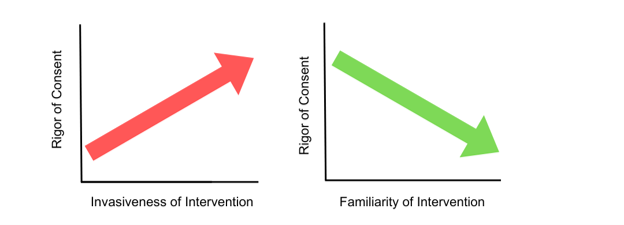
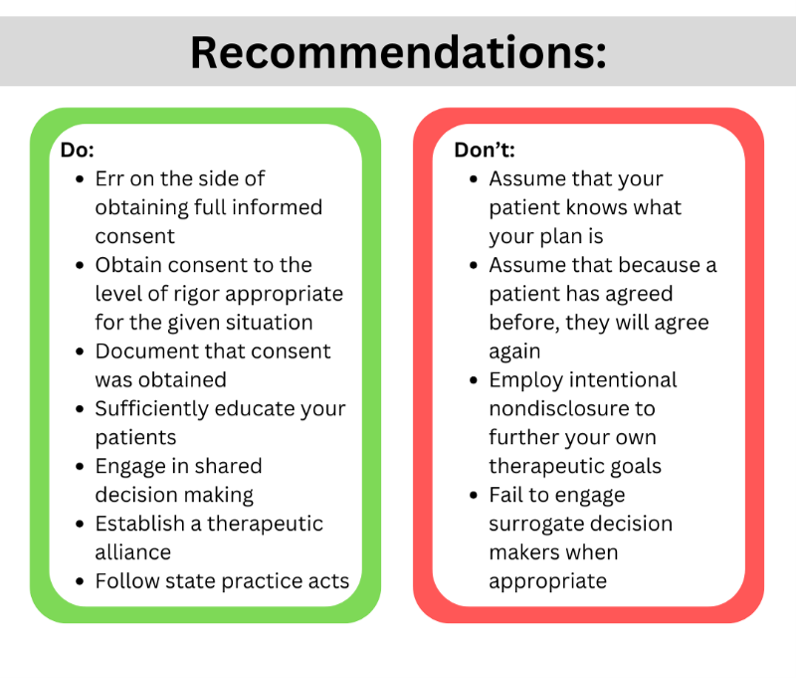
Figure 2 features recommendations for best practices in consent for physical therapy, developed by integrating the evidence presented throughout this piece. The physical therapist or physical therapist assistant should always err on the side of obtaining full informed consent. While it may be appropriate in other instances to use a lower level of rigor for a given situation, when in doubt, the most protective thing that a provider can do for themselves, and their patient, is to obtain informed consent. It may also be appropriate for the provider to document, in some fashion, that consent was obtained—including in the patient’s medical record. Failure to document that consent was obtained, even if discussion between the patient and provider transpired, may result in legal risk to the provider.5,8
Practice Environments and Consent
It is worth considering differences in practice environments. In an outpatient care environment, a patient is entering an episode of care with a particular provider, establishing the previously-described fiduciary relationship. However, in an inpatient environment, the patient may have widely consented to receiving healthcare in that setting and may require more explicit discussion about the role of the physical therapist or physical therapist assistant as an element of their care. Ensuring that the foundational criteria of information disclosure has been met is integral to high-quality patient care interactions.4,25
Many may routinely document that a patient consents to receive physical therapy services but, particularly for invasive interventions (eg, dry needling, sharp debridement), the completion of an informed consent form may be warranted. Documentation of a patient’s written consent may serve to bolster legal protection for the physical therapist, particularly in the instance of an adverse event.5,8
Physical therapists and physical therapist assistants should always follow their state practice acts when considering their legal obligations, as well as documents—like the Code of Ethics, and the Core Values for the Physical Therapist and Physical Therapist Assistant—to appreciate the fiduciary nature of their role.1,26 Patients should always be educated regarding the plan of care, and the therapeutic relationship between patient and provider should be fostered throughout a course of care. Incorporating shared decision making can be an essential component of the plan of care.27
Physical therapists and physical therapist assistants should:
- Not assume that their patients know what their plan is.
- Not assume that because a patient has previously consented to a given intervention, they will agree to that same intervention again.
- Avoid employing intentional nondisclosure to further their therapeutic goals.
- Preference shared and collaborative decision making over a paternalistic approach to treatment.
In the event that a patient is unable to provide assent or tacit consent to physical therapy services, which may be the case in our Case 1 example, the provider should seek to engage a surrogate decision maker or healthcare proxy to obtain informed consent when able and appropriate.
Taken together, these recommendations may help protect patients and providers, ensuring a knowing engagement in physical therapy services.
Maximizing patients’ understanding of physical therapy interventions and ensuring that consent is obtained throughout an episode of care has the potential to optimize the public perception of the profession, both increasing professional accountability and visibility, and providing greater knowledge of the depth and breadth of the scope of physical therapist practice across the continuum of care.
Conclusion
Obtaining informed consent is an essential component of physical therapist and physical therapist assistant practice and is a means by which to respect patient autonomy. However, it can be challenging to balance the demandingness of true informed consent with fostering a therapeutic alliance. Therefore, physical therapists and physical therapist assistants may consider appropriate utilization of other forms of consent in the larger context of a consented plan of care, to maintain efficacy and efficiency. As physical therapists and physical therapist assistants embrace the newly revised APTA Code of Ethics, this nuanced approach to the standard of care may maintain the spirit of the standard, while improving feasibility. When in doubt, providers should err on the side of obtaining full informed consent for improved patient understanding and engagement in their care, as well as decreased legal liability for the provider.


This work is licensed under a Creative Commons Attribution 4.0 International License.