

I did not expect Tinder to change how I understood empathy.
As a newly-minted faculty development resident in a Doctor of Physical Therapy (DPT) program, I was assigned to grade a familiar rite of passage in physical therapy education: the 24-hour wheelchair experience. Several years after experiencing it as a student, I found myself on the other side of the experience. Historically, DPT programs have used this assignment to encourage empathy, increase awareness about accessibility, and expose students to disability. The assignment’s intention is noble. The hope is that experience will mitigate assumptions and biases in ways that lectures cannot. But this time around, I couldn’t help feeling “icky” about the assignment. Was it because I now had years of clinical experience working with wheelchair users? Was it because I had witnessed former classmates approach the assignment without sincerity? Was it because times had changed?
When I completed the experience as a student, I approached it with what I believed were the unspoken rules of the assignment: professionalism and seriousness. I navigated a grocery store. I attempted to enter the pool area of my apartment. I struggled to negotiate heavy doors, narrow aisles, and awkward transfers. My second-floor bedroom was impossibly inaccessible. I noted the shelf heights of my favorite snacks and the utter disrepair of most sidewalks. I described looks and feelings of pity, real or imagined, from strangers. My reflection was thoughtful but controlled. I wrote about architecture and inconvenience. I wrote about access and effort. Like any diligent student physical therapist, I examined the environment as though it were a problem to solve. I did not, however, examine myself.
The paper I was grading that afternoon made me all too aware of that, as I read: “…and I had the feeling everyone else was going to write about accessibility.”1(p1)
A Startling New Perspective
The student described spending their 24 hours in a wheelchair while going on a first date—a Tinder (online networking app) date. Scandalous, right? Figure 11(p2) shows the student’s Tinder profile. Playful pokes at the evidence-based nature of our profession, like this, were peppered throughout the paper. “Instead of writing about the physical struggles of being in a wheelchair, I wanted to explore a social aspect of being in a wheelchair,”1(p1) the student expressed. They reported how they intentionally chose not to disclose beforehand that the wheelchair was part of an assignment. They arrived in the chair. Ordered (and spilled) a drink in the chair. Navigated the restroom in the chair. Continued the evening in the chair. And their date treated them…normally.
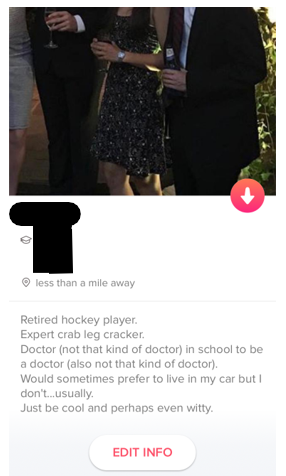
As I read, my initial reaction was uncertainty. Was this appropriate? Was the student taking this “seriously”? As I kept reading, the tone of the reflection shifted quickly from originality (and a little comedy) to vulnerability. The student described the anxiety of meeting someone new while being visibly disabled. They wrote about wondering whether attraction would change and whether physical difference would become the defining feature of the evening. They described bracing for pity or patronization, but instead encountered ease: “I hate for this paper to be boring, but…(they) didn’t make it weird at all and it was probably the best first date I’ve been on.”1(p3)
Later, they returned to their date’s apartment, “where the plan was to drink water and watch TV,”1(p3) and…it was ADA accessible! “It was basically fate,”1(p3) the student wrote. A smile sneaked across my face. As I continued reading, it became more apparent that this was not a superficial experiment for the student.
They had placed themselves in a context where disability intersected desirability.
They had not limited the wheelchair to transactional spaces like grocery stores or sidewalks. They had brought it into intimacy. And that level of intimacy was exactly what I had avoided in this experience as a student.
My own 24-hour experience did not account for the emotional variability that any individual faces each day, able-bodied or not. I selected predictable environments. I remained the observer of barriers, the temporary inhabitant of inconvenience. I approached the experience like a to-do list to be checked off, not as an experience. I was detached, unaffected—robotic, even. At the end of the day, I stood up and returned the wheelchair. But this student’s narrative forced me to face the temporary nature of this assignment as if I were experiencing it for the first time.
Moving Beyond ‘Tourism’
Simulation exercises in health professions education frequently aim to develop empathy by approximating lived experience. Yet disability scholars have long cautioned that such simulations can unintentionally reinforce the idea that disability is reducible to physical limitation or momentary frustration. Reading this paper, I began to see how easily the 24-hour wheelchair assignment can slip into “empathy tourism,” or the practice of engaging with marginalized communities in order to experience their hardship.2 The goal is for the “tourist” to gain a deeper emotional understanding of an issue, and honestly, my own reflection years earlier had flirted with this plot: I was uncomfortable, inconvenienced, socially hyperaware. And under it all was the relief that it was temporary.
By entering a first date without disclosure, the social interaction unfolded without anticipatory justification. In that space, the student confronted not just physical barriers but also the negotiation of identity: Am I attractive? Autonomous? Equal? The student did not describe striving to prove capability.
They described being allowed to exist without explanation.
As I thought more deeply, I recognized that my earlier understanding of empathy had been rooted in problem-solving. I believed empathy meant recognizing barriers so I could later remove them for my patients. That belief is not wrong, but it is incomplete. Empathy also requires confronting the power we hold as clinicians. We assess, prescribe, document, and discharge. Even when well-intentioned, our lens can become evaluative rather than relational.
Educating the Educator
As an educator, I was also holding power. I held the metaphorical red pen. I decided what counted as “deep reflection.” I assigned grades. Reading this paper, I felt the opposition between rubric and reality. If I had graded depth of reflection solely on environmental evaluation, I might have missed the meaningful relational learning unfolding on the page.
The student’s reflection also forced me to examine my own assumptions about what constitutes “appropriate” engagement with an assignment. I initially equated seriousness with rigor. But what if depth is translated through humor? What if humanity is revealed not by cataloging curb cuts but by risking rejection?
We are not simply teaching students to identify barriers. We are facilitating how they will sit with patients whose identities have shifted in ways not captured by outcome measures. Disability is not experienced solely in public infrastructure. It is also experienced in private dialogues of worth.
By the end of the paper, the student shared that they were now officially dating their Tinder connection. The ending felt cinematic. But what stayed with me was not the romance.
It was the idea that disability does not disqualify partnership.
As clinicians, we speak frequently about returning patients to community participation. Yet we rarely discuss dating, intimacy, or sexuality in our curricula with the same importance we grant stair negotiation.
Choosing Evidence or Understanding?
Twenty-four hours in a wheelchair can reveal a lot. Most importantly, it can reveal that empathy is not produced by proximity alone. It is produced by reflection and by allowing the experience to unsettle us. Twenty-four hours in a wheelchair did not fundamentally change my perspective when I was a student. I completed the task, wrote the paper, and moved on. Looking back, I realize I was searching for evidence rather than understanding.
I documented barriers, frustrations, and inconveniences because those were the outcomes I expected to find. What I failed to recognize was how narrowly I had defined the experience. I never considered questions of identity, belonging, attraction, or dignity. In many ways, I approached disability as a problem to observe rather than a human experience to understand. The assignment ended exactly where I expected it to end: with a paper. This student’s reflection lingered because it exposed how much of the experience I had unknowingly excluded.
But reading about 24 hours that evolved into vulnerability, and eventually, marriage (yes, marriage!), shook my confidence as an educator. It compelled me to reconsider what we are truly asking students to learn.
Navigating a Course Change
I no longer assign this experience in my courses. Now, I read this student’s reflection out loud in class.
I acknowledge the limits of the assignment. Instead, as a group, we discuss not only physical barriers but also examine power, identity, and how an individual’s relationships shift with disability. And every year, I remain surprised at how much this one student’s experience and candid reflection open the door to conversation. Maybe it’s the relatable references to Tinder and Snapchat, or the student’s bold pursuit of love and simultaneous commitment to coursework. And every year, students thoughtfully discuss the same theme: Disability is not a costume to try on, but reality shaped by human interaction.
What strikes me is that students arrive at these conclusions even though they have not completed the wheelchair assignment themselves. Ironically, the lesson seems to emerge more clearly through critical discussion of the experience than through the simulation itself. Rather than focusing on what it feels like to sit in a wheelchair for a day, students grapple with the limitations of believing that such a brief encounter could represent disability. The conversation shifts from “What would this be like for me?” to “What assumptions am I bringing to my understanding of someone else’s life?” For me, that distinction has become far more educationally valuable.
Perhaps the challenge for physical therapy education is not determining how to simulate disability more realistically, but deciding whose stories we invite students to learn from. If we hope to cultivate clinicians who practice with humility, we must create opportunities for learners to engage with disability as a lived experience rather than a clinical problem. That work requires more than exposure. It requires listening.
“Quality of life includes more than being able to reach things,”1(p1) the student reflected. And I couldn’t agree more. Because sometimes the most transformative learning does not occur in the grocery aisle or at the edge of a pool. Sometimes it unfolds across a dinner table, in the space between two people, in which dignity is either affirmed or quietly diminished.
Empathy, I am still learning, is not something we simulate.
It is something we practice, especially when our borrowed wheels are returned, and we are left to decide what, if anything, has truly changed. As educators and clinicians, that decision matters. We can continue searching for brief experiences that promise understanding, or we can create space for the voices, relationships, and lived realities that challenge our assumptions long after an assignment ends. The future of disability education may depend less on asking students to imagine disability and more on teaching them how to listen.


This work is licensed under a Creative Commons Attribution 4.0 International License.