

“Catch” and “Phantom”
doi: 10.18737/0607160213
AMA Citation: Bell E. “Catch” and “Phantom.” J Hum Rehabil. 2026; Fall. DOI: 10.18737/0607160213
Table of Contents
Catch
The referral says edge-of-bed tolerance.
He is C6, three weeks out.
I feel as if I am
practicing on his tragedy.
His legs hang over the side.
His trunk holds itself upright
by intention that used to be automatic.
I stand behind him,
my torso braced against the mattress,
my hands on the gait belt at his waist.
My badge says technician,
yet my hands are trembling.
The therapist stands at his knees.
He is holding the midline.
Then his weight shifts to the right
without him asking it to,
and the correction does not come.
I catch him with my body
before I catch him with my hands —
my chest against his back,
his full weight falling into the space
I have made with my torso.
He screams.
I pull him upright.
I do not speak.
Something between us has come loose.
He does not want to try again.
We try again.
The therapist talks him through the transfer.
I am the only thing between him and the floor,
a half-step behind,
one hand free to catch
what I already failed to catch.
He grips the armrests
with hands that are only learning
to grip things again.
He does not let go.
I am still learning what my body can hold.
When the therapist steps away
he asks where she is going.
When I step away
he asks where I am going.
He wants to be held
by more than his own trunk.
Phantom
The wound vac hums
at the end of the bed,
a low mechanical breath.
The left leg ends
six inches above the ankle.
The surgeon took the foot in October
a clean line, a binary choice:
the limb or the life.
But the brain is a stubborn archivist.
It refuses to delete the coordinates
of a heel that no longer touches the floor.
We tell him we are going to the chair.
He nods. His jaw sets before his body does.
I see it first in the tendon at his throat,
then in the clench of his hands,
then in the leg, no longer a leg
that has begun to burn.
We roll him toward the edge.
He tenses.
The burning deepens.
He has learned already
that fear is a flame,
that absence can feel.
The therapist says I can imagine.
He says how could you possibly.
And the room becomes two countries.
One where the foot is gone,
one where the foot is a fire
no one can warm their hands against.
We make it to the chair.
He sits, hands gripping the armrests,
the right one planted on the floor,
the left one hovering? above it
He asks how to get back.
Not when. How.
As if the return trip
passes through its own country,
its own weather,
its own language of pain.
The wound vac hums.
The absence burns.
I stand behind the chair,
my hand on the backrest,
trying not to think
about what I cannot imagine.
About the Author
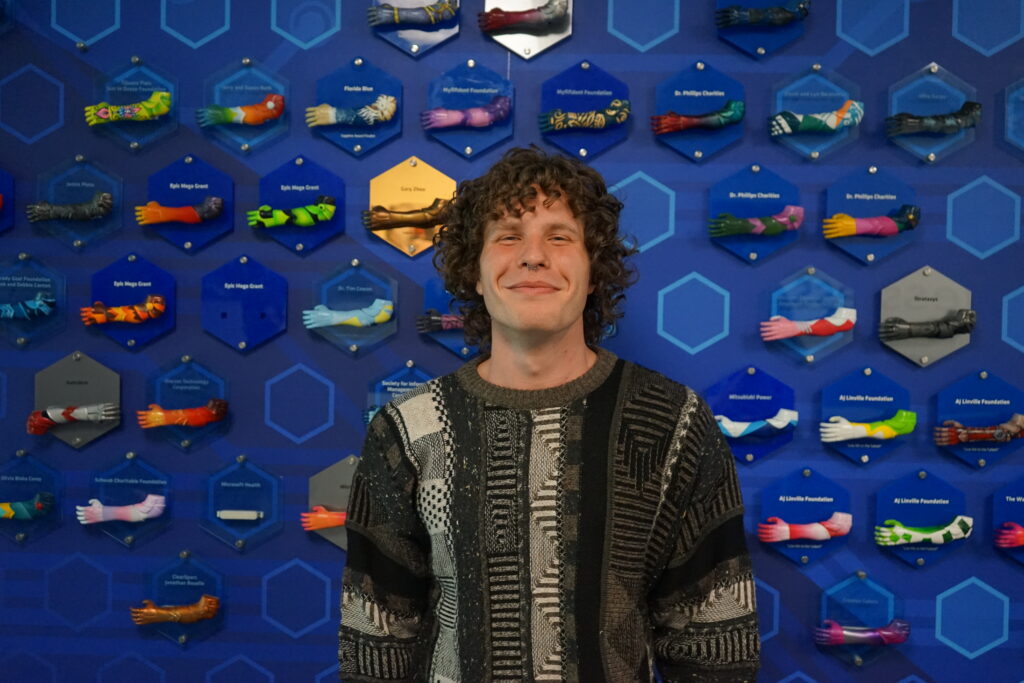
Ethan Bell
Ethan Bell is a premedical student at the University of Central Florida, a rehabilitation technician at a Level 1 trauma center, and a clinical researcher at a pediatric prosthetics lab in Orlando, Florida, where he studies upper-limb EMG prostheses. He previously worked as an EMT and is training as a medical interpreter through the Certification Commission. His narrative writing has appeared in the Journal of Palliative Medicine and Intima, with work forthcoming in Academic Medicine and CMAJ.

This work is licensed under a Creative Commons Attribution 4.0 International License.