Abstract
Person-centered care (PCC) is critical to maximizing patient outcomes in physical therapy (PT). This is especially true in today’s uncertain climate of health and social transformation, increasing patient complexity, diversity, health inequity, and rising prevalence of chronic diseases. As PCC becomes a more prominent model of care, it has become increasingly clear that the current biomedical focus in PT education isn’t fully preparing students for the relational and cultural aspects of patient care.
In this perspective, we respond to the calls of other authors for a re-imagining of PT education by advocating for the explicit integration of the humanities into PT curricula. We argue that the humanities, through disciplines such as literature, philosophy, ethics, and the Arts, offer powerful pedagogic approaches that support competency-based education while cultivating reflective, adaptable, and morally-grounded clinicians. We acknowledge the barriers to this integration and propose strategies for implementation, ultimately emphasizing the critical role of the humanities in developing clinicians who can skillfully balance both science and soul in PT practice.
Introduction
“In the heart of California’s Merced community, a poignant tale unfolds—the story of Lia Lee, a Hmong child whose life becomes a battleground of cultural discord and medical ethics. At three months old, Lia experiences her first epileptic seizure, an event her parents interpret as qaug dab peg, or “the spirit catches you and you fall down,” signifying a spiritual encounter rather than a mere medical condition. To the Hmong, such seizures are both alarming and auspicious, often believed to mark an individual as destined for shamanic greatness. However, the Western physicians overseeing Lia’s care view her epilepsy through a strictly biomedical lens, prescribing complex regimens of anticonvulsants aimed at controlling her seizures. This chasm between cultural beliefs leads to profound misunderstandings: the Lees, wary of the medications’ side effects and convinced of their spiritual approach, struggle with adherence, while the doctors, perceiving noncompliance, resort to drastic measures, including placing Lia in foster care to ensure medical protocols are followed. The tragic outcome—a severe deterioration in Lia’s condition—serves as a heartwrenching testament to the perils of Western ethnocentrism in healthcare, underscoring the imperative for cultural humility and the integration of the humanities in medical education to foster truly person-centered care.” — Summary of “The Spirit Catches You and You Fall Down.”
Ann Fadiman’s ethnography, “The Spirit Catches You and You Fall Down,”1 is a shocking illustration of the failure of Western healthcare’s blinkered biomedical approach in situations of conflicting perspectives. Fadiman’s work challenges the dominant Western healthcare paradigm, in which consideration of a patient’s beliefs, values, and cultural understandings is optional, not compulsory.2 Her analysis reveals significant gaps in contemporary medical education—specifically, its failure to train students in the healthcare of the person rather than of a patient. Most health professions remain closely aligned with the biomedical approach to patient care.
Over the last several years, scholars across the health professions, including medicine and physical therapy, have highlighted the need for a renewal and reframing of education to:
- Prioritize a more humanistic approach centered on caring for the person behind the patient.
- Create more ‘adaptive learners’ and socially responsible clinicians in this new era of healthcare transformation.3-5
In this article, we join these scholars in their calls for health professions education to cultivate greater humanism in students, helping them to understand that ‘seeing patients’ souls’ is as, or more, important than fixing their bodies. We emphasize the need for curricula to enhance students’ understanding of the critical role of situated knowledge and cultivate competence in person-centered care.
Person-Centered Care
Person-centered care (PCC) is a complex and multidimensional approach to patient care that prioritizes understanding the patient as a unique individual in their life context, with their own values and perspectives for how they want to participate in their healthcare experience. PCC is an emergent and dynamic process that materializes through the ongoing interactions and interconnections of various factors, including the patient’s physiology, cognition, social circumstances, the healthcare environment, and the healthcare provider.6
A recent qualitative study on patient and physician perspectives on PCC, by Rauseo et al,6 affirms PCC as relational, collaborative, and reciprocal. It requires a strong therapeutic alliance between the patient and clinician that fosters the sharing of power and responsibility in healthcare decisions, and participation of the patient in their recovery in a coordinated manner within the healthcare system.7
Barriers to PCC
Patient-centered care is fundamental to physical therapy practice and embodied within the core values for the profession.8 The concepts of communication, collaboration, and patient/caregiver empowerment are integrated into both the Code of Ethics and Standards of Practice established by the American Physical Therapy Association (APTA).9,10 Despite this explicit professional commitment, translation of PCC to practice remains challenging. Barriers include poor or fragmented communication and a lack of knowledge and training for effective PCC.
Communication barriers stem from cultural and language gaps between patients and clinicians, as well as the biases, prejudices, and cultural ignorance of healthcare providers.11–13 These gaps primarily affect patients from historically underserved communities, placing them at risk of receiving poor care. In a review by Schouten and Meeuwesen11 all studies reported lower scores on physician empathy, building the therapeutic alliance, provider responsiveness towards patients, providers’ expression of positivity, and providers’ social talk in consultations with patients from ethnically marginalized groups compared to white patients. Additionally, nonverbal cues have different meanings across cultures, further complicating the issue. Misunderstandings and discomfort from fractured communication can inhibit PCC through a poor therapeutic alliance and cause harm to the patient, as demonstrated in Lia’s story.
A lack of knowledge and training in PCC is the most frequently cited barrier to implementing PCC.12,14–17 Physical therapists trained only in the biomedical approach to care may lack the skills to encourage shared decision-making and cultivate the therapeutic alliance. Although practice guidelines suggest a biopsychosocial approach to patient care, this approach is poorly understood and implemented, and there is often a lack of adherence to guidelines among biomedically-focused healthcare providers. However, even those trained in the biopsychosocial model may lack the clinical expertise to deliver PCC effectively. Authors have described a poor understanding of PCC by clinicians, emphasizing the need to educate providers on the application of PCC and orient them to action in clinical practice.12,14,17
These challenges to PCC reflect the physical therapy profession’s grounding philosophies of positivism and biomedicine, in which the body is viewed as a machine. Nicholls18 expressed concerns with what he calls the ‘physiotherapy paradox,’ where the body-as-machine approach, upon which the profession found its great success, now threatens to derail it. He and other authors5,19 argue that this biomedical approach has sidelined the psychosocial, spiritual, and cultural aspects of care and reduced access of marginalized people to physical therapy. Piemonte4 echoes this concern, stating that this scientific epistemology provides only a partial and decontextualized understanding of the patient, whose body is viewed as a ‘diseased body-object.’
According to Nicholls et al,20 “while Western biomedicine may have brought a great deal of social capital and prestige to physiotherapy, it has created a curriculum that is too narrow, a practice that is too mechanical, a therapeutic context that is too binary, and an approach to thinking that is too abstract and instrumental.” Health professions education, Miles et al note, must recognize that “medicine is primarily a human activity with a moral character that employs science, but does not equate to it.”2
With this in mind, this perspective underscores the urgent need for a reimagined approach to physical therapy education that meaningfully integrates the humanities to more effectively prepare PTs for the complexities of delivering authentic PCC at both the individual and societal levels. Physical therapy education must be grounded in a more humanistic and relational framework that prepares students to think more critically and more creatively, navigate uncertainty, and engage more compassionately and appropriately with diverse and marginalized populations, ensuring that the profession keeps pace with the rapidly-evolving health landscape.
The Value of the Humanities in Person-Centered Care
The humanities encompass a range of subjects, including Literature, History, Philosophy, the Arts (film, theatre, music, dance), sociology, and anthropology. Sociology explores human culture, behavior, values, and experiences. Anthropology is the study of humanity. Frank21 goes so far as to state that “medicine as a discipline is a subset of anthropology, the study of humans,” a statement that can easily apply to physical therapy.
The humanities have instrumental value in healthcare education, shaping professional identity, communication, ethical decision-making, and empathy, indirectly improving outcomes.22 By fostering deeper clinical reflection, they help cultivate self-aware and compassionate practitioners.22 In a systematic review and meta-analysis by Howick et al,23 greater clinician empathy enhanced patient outcomes. The humanities develop graduates’ understanding of the human condition and an appreciation for their place in the world, their connections to others, and their functions in society.24 They develop students’ ability to welcome other perspectives, providing frames of reference for understanding and navigating complex patient problems and ethical dilemmas. Through understanding cultural norms and differences, students moderate their own biases, and develop a sense of reflexivity and a “critical and questioning attitude” toward decision-making and problem-solving.25
The humanities also help develop emotional responses.26 The link between the humanities and emotion and cognition is well-established.27 Emotion guides learning, decision-making, and behavior, which may explain how narrative fosters clinician empathy and supports patient education and behavior change. In this way, the humanities can mitigate some of the dehumanizing effects of the hidden curriculum of a strictly biomedical education.
Cultivating Broader Perspectives
In addition to their instrumental value, the humanities may have a more intrinsic value. Blease25 claims that incorporating the humanities in the scientific curriculum creates a student with a more questioning and humble attitude, one with a broad perspective, which he differentiates from the more narrow and focused ‘training’ provided in typical medical schooling. With their broader perspective, these students may more readily connect with patients from diverse backgrounds and differing worldviews, fostering a stronger therapeutic alliance.
A Reciprocal System
PCC is rooted in an ecological philosophy, where patients and providers are embedded in a dynamic and reciprocal system, which includes their social, cultural, and physical environments. PCC emphasizes holistic care by understanding how the players in healthcare interact with and are affected by this system. The humanities support this philosophy, emphasizing the social, emotional, experiential, and cultural aspects of health. In doing so, they promote students’ appreciation of the historical, cultural, and sociopolitical forces that guide health beliefs and drive issues of healthcare and equity.
The Current State of Physical Therapy Education
Physical therapy has been shaped by Western biomedicine, which has guided physical therapists’ perspectives on illness ontology and their epistemology of the “body as a machine.”18 As such, PT education core topics are taught first and include Anatomy, Physiology, Clinical Pathology, and Biomechanics/Kinesiology, with limited exposure to the humanities. The hidden curricula of this biomedical focus are mechanistic thought and binary approaches to care, which facilitate power differentials between the patient and the provider and jeopardize PCC, as demonstrated in Lea’s story at the beginning of this article.
Although modern PT is embracing a more biopsychosocial approach, there remains a strongly held biomedical perspective and a suboptimal understanding of the integration of biopsychosocial factors to achieve PCC.19,28,29 This reflects the continued empirical and reductive focus of PT curricula and the predominantly quantitative-focused research methods that overlook the more humanistic philosophies central to PCC.
Limited Qualitative Research
Despite the power of qualitative methodologies to assist students in understanding the human condition,30 Wormley et al31 found that DPT programs in the United States, on average, allocate only 5 hours to teaching qualitative research. Furthermore, a recent study32 evaluating excellence and innovation in PT education found far greater emphasis on habits of “head” (cognitive) and “hand” (psychomotor skills) than on “heart” (affective and professional formation). There was little assessment of the qualitative nature of performance or provider behavior. The authors also highlighted a lack of “philosophical commitment to the profession’s non-negotiable broader social responsibility” and stated that “both professional formation and the ethical foundation of practice and professional commitments in society were of limited scope.”
The distressing lack of exposure to qualitative methods limits the opportunities and practical tools available for students to develop moral agency, or the capacity to act for change in situations of health inequity or social injustice, which is counterproductive to principle #8 in APTA’s Code of Ethics for the Physical Therapist.9
Continued Need for Cultural Competence
PT’s eurocentric pedagogy may not reach students from minority or marginalized groups, a concern in today’s world of increasing students from culturally-diverse backgrounds. Educators, of whom 81% identify as White in the United States, often adopt a ‘one-size-fits-all’ approach that lacks cultural responsiveness and nuance.33 This issue is not limited to Western countries. Lai et al34 found that PTs in Hong Kong have lower levels of cultural competence compared to occupational therapists due to a lack of training, and that these PTs expressed lower willingness to receive further competency training.
PCC on the PT Education Horizon: A Case for Competency-Based Education
A growing body of evidence18,28,32,35 underscores the urgent need for PT curricula to adopt a more socially-attuned and ethically-grounded orientation that prepares students not only as skilled technicians but as moral agents with sound professional identity, capable of navigating complex human experience. Some authors have declared the critical need to improve PCC education in PT programs, with McDevitt36 asserting that “the development of these (person-centered) skills should be regarded as a priority in PT practice and across the education continuum from entry-level to post-professional training.”
Peixoto,5 who advocates for the “Social Physiotherapist” as an autonomous social architect and active political agent, argues that “training must counter the reductionist impulse of measurement through a profound reform in pedagogy, promoting clinical reasoning and sociological imagination, prioritizing History, Philosophy, Psychology and Sociology.” Such a shift is essential, Peixoto notes, if the profession is to move beyond the constraints of the biomedical model and resolve the enduring “physiotherapy paradox.”
Achieving such a profound pedagogical shift requires more than curriculum reform. It demands a transformation in how students understand themselves, their patients, and the structures of power that shape both.
In Freire’s critical pedagogy, conscientization is the process by which a student becomes aware of the historical, social, and power structures that constrain or facilitate choices in a particular context.37 It is the engine of transformative learning, whereby the PT crosses from their “body-as-machine/normative” paradigm to understanding the patient “narrative/qualitative,” changing fixed mindsets to become more inclusive and open to change.37 This is necessary to move from merely observing patient suffering, to diagnosis and addressing the contributing social inequities as a moral agent.37 Thus conscientization, which requires the humanities, can be considered the pedagogy of moral agency.
Competency-Based Education
Some progress has been made to move PT education in this direction through competency-based education (CBE), which provides the framework for assessing such abstract concepts. Competency-based education stresses that advancement in education should be based on the demonstration of skills and abilities rather than on time-based progression. These competencies have “an uncompromising focus on translating the needs of contemporary society for improved health care into competencies that must be mastered by health professionals across all disciplines.”38 This approach moves away from the reductionist biomedical education models, better equipping new PTs to meet evolving individual and societal health needs and deliver effective PCC.
In support of this, the American Physical Therapy Association (APTA) recently published a report on CBE, detailing 8 domains or categories of competence (Table 1) that encapsulate the spirit and principles of the profession. These domains describe “competencies” or the measurable and observable skills and attributes of the student at entry level into practice.38 The humanities can seamlessly facilitate the development of these competencies delineated in the domains. The following section elaborates on how the humanities can enable student mastery of the competencies and provides examples of their application in PT education.
Table 1: Domains of Competence (APTA report)38
Domain of Competence | Description of Domain | Example of competency within Domain |
Knowledge for Practice | Physical therapists demonstrate the ability to identify, organize, synthesize, integrate, and apply knowledge and skills specific to physical therapist practice, as well as related knowledge from other disciplines, to improve health care for patients and populations. | Integrates comprehensive knowledge in foundational, behavioral, social, and clinical sciences across diverse patient populations of practice settings. |
Communication | The physical therapist communicates using verbal, nonverbal, and written communication, demonstrating cultural humility, to effectively exchange information and enhance therapeutic and professional relationships in varied situations and circumstances. | Evaluates and adapts communication strategies to meet the needs of individuals and populations. |
Patient and Client Care and Services | Physical therapists apply principles of evidence-based practice and clinical reasoning to the Patient and Client Management Model through shared decision-making to achieve desired health outcomes. | Incorporates the characteristics of the patient or client characteristics to develop and implement a person-centered, comprehensive examination. |
Professionalism | Physical therapists demonstrate cultural humility and a commitment to high standards of ethical behavior, exhibit appropriate professional conduct, and advocate for a health system that enhances the well-being of the patient and client, society, and the profession. | Recognizes how differences in background, experience, and access to resources impact care. |
Practice Management | Physical therapists prioritize needs and manage resources to ensure safe, legal, ethical, effective, and sustainable services. | Balances patient or client needs with caseload volume, considering available time, equipment, and personnel when providing services. |
Reflective Practice and Improvement | Physical therapists appropriately evaluate the care and services of patients and clients to continuously improve practice and outcomes throughout their careers. | Uses internal and external sources of information to develop expertise that promotes the ability to adapt to unknown or evolving situations. |
Education and Learning | As educators, physical therapists demonstrate teaching skills that facilitate learning by patients and clients, caregivers, colleagues, students, and communities. | Identifies audience learning needs, considering preferences and abilities, the role of culture, family-related constructs, environmental factors, and personal factors, to develop a plan. |
Systems-Based Practice in Health Care | The physical therapist demonstrates awareness of and responsiveness to the larger context of health care systems and health policy and engages in quality improvement to provide care and services that are of optimal value. | Appraises the relationship between social determinants of health and the health system in which the physical therapist practices. |
The Humanities As a Solution: Practical Applications in PT Education
The rise of value-based care models, patient autonomy, and diverse patient populations necessitates skills that extend beyond traditional clinical competencies and knowledge. The need for students to establish a firm professional identity as socially-responsible agents of change requires reflection and opportunities to embody professional roles beyond the clinic.39 The humanities are a practical solution to the aforementioned challenges in PT education, and can be particularly effective at developing competencies within the domains of CBE (Table 2).
Carr et al22 support the humanities in core health curricula, stating that they “could re-integrate the inevitably reductive forms of biomedicine and produce an education that is authentically centred on caring for the ‘person in context.’” Frank21 notes that when we “internalize the teaching of the humanities,” we become more skilled at integrating scientific complexity with cultural sensitivity and better adept at PCC. We put the soul into the science. A case for the humanities is a case for the “heart” of PT practice.
Table 2: The Incorporation of the Humanities Into CBE Through Integrated Pedagogical Techniques
Forms of Humanities | Functions/Skills Enhanced | Corresponding Competencies | Integration |
Philosophy and Ethics | 1. Broadens the conceptual frameworks (eg, enactivism/disposition-alism) students can use in clinical reasoning.2. Challenges students to examine ethical assumptions, power dynamics and value systems underlying clinical decisions.3. Cultivates tolerance for uncertainty and critical questioning, which is central for creative thinking and adaptive expertise. | 1. “Integrates comprehensive knowledge in foundational, behavioral, social and clinical sciences across diverse patient populations and practice settings.” (KP)2. “Recognizes how differences in background, experience, and access to resources impact care.” (PR)3. “Uses internal and external sources of information to develop expertise that promotes the ability to adapt to unknown or evolving situations.” (RP) | Case-based discussions; elective courses. |
Literature/Storytelling | 1. Narratives teach students to recognize how illness is communicated differently across cultures, experiences and contexts.2. Reading illness narratives from diverse cultures cultivates bias recognition and cultural humility.3. Understanding the lived experience through narrative directly supports person-centered examination and shared decision-making.4. Narrative competence helps the PT tailor patient education to the individual’s story or context. | 1. “Evaluates and adapts communication strategies to meet the needs of individuals and populations.” (CO)2. “Demonstrates cultural humility.” (CO)3. “Incorporates the characteristic of the patient or client to develop and implement a person-centered, comprehensive examination.” (PC)4. “Identifies audience learning needs, considering preferences and abilities, the role of culture, family-related constructs, environmental factors, and personal factors.” (EL) | Selected readings on conditions written in narrative form, by physicians or patients, patient education via metaphors, and patients as guest speakers. |
Art/Visual Thinking Arts | 1. Sharpens non-verbal awareness and attunement to the emotional and symbolic aspects of communication.2. Analysis of artwork of persons with illness integrates understanding of pathology with the behavioral and existential dimensions of living with chronic conditions.3. Visual tools enhance the PT’s ability to tailor health communication to diverse groups. | 1. “Communicates using verbal, non-verbal, and written communication demonstrating cultural humility.” (CO)2. “Integrates comprehensive knowledge in national, behavioral, social, and clinical sciences.” (KP)3. “Identifies audience learning needs, considering preferences and abilities, culture, and personal factors.” (EL) | Study the artwork of persons with illnesses, create diagrams of philosophi-cal concepts, patient education documents. |
Theatre/Drama/Music | 1. Role play and improvisation develop real-time adaptive communication skills in complex, emotionally-charged clinical scenarios.2. Theatre-based learning exposes students to diverse perspectives and emotional experiences, deepening cultural humility.3. Improv builds the listening, presence and responsiveness skills needed to support genuine shared decision-making in the clinic. | 1. “Evaluates and adapts to communication strategies to meet the needs of individuals and populations.” (CO)2. “Demonstrates cultural humility.” (CO)3. “Incorporates shared decision-making to achieve desired health outcomes.” (PC) | Role play, improv |
Journaling/Writing | 1. Journaling cultivates metacognition and self-assessment, which are foundational to reflective practice and lifelong learning.2. Reflective writing helps students process ethical dilemmas, emotional responses to clinical encounters, and the moral dimensions of their professional conduct, directly supporting professional identity formation. | 1. “Uses internal and external sources of information to develop expertise that promotes the ability to adapt to unknown and evolving situations.” (RP)2. “Demonstrates a commitment to high standards of ethical behavior and exhibits appropriate professional conduct.” (PR) | Journaling about clinical experiences, reflective discussions. |
Kolb’s Experiential Learning Theory posits that a person learns best through a cyclical process of action or experience rather than receiving passive information.40,41 The cycle consists of four stages:
- Concrete experience.
- Reflective observation.
- Abstract conceptualization.
- Active experimentation.
Each humanities activity described below intentionally engages all four of Kolb’s stages, making the humanities not merely supplementary content, but a structurally-sound, theoretically-grounded pedagogical approach to teaching these critical, less tangible skills of PCC through the competencies of CBE.
Integrating Humanities Into CBE
Table 2 shows how the different humanities can be integrated into CBE, by addressing many of the competencies in each domain.
Philosophy and ethics, for example, strengthen moral reasoning and decision-making skills, which inform professional behavior and guide the patient-provider relationship.42 This supports specific CBE competencies, including the ability to integrate behavioral and social sciences into practice (Knowledge for Practice); adapt to evolving or uncertain clinical situations (Reflective Practice and Improvement); and recognize disparities in access and background (Professionalism). This latter competency aligns with conscientization, encouraging advocacy and moral agency.37
According to Kolb’s learning theory, philosophical texts provide the concrete experience that prompts the student to question biomedical assumptions through reflective observation. For example, Nicholls,18,20,43 drawing from the philosophical “posts,” opens up a world about a “different physiotherapy,” one that is more socially conscious and expansive than the profession’s biomedical focus depicts. Gibson’s44 post-critical approach urges us to question our assumptions about entrenched foundations of rehabilitation and think beyond the dichotomies of normality/abnormality, independence/dependence; question power relations; and reimagine a practice that values diverse abilities.
Indeed, understanding the current frameworks that underpin the way we describe structure, function, malfunction, restoration, and rehabilitation, including their boundaries and the extent of their interdependency, is critical to a clinician’s ability to take realistic perspectives and make ethical decisions, aligning with the active experimentation stage of Kolb’s Learning Theory.41,45
Several other philosophies are indispensable to physical therapy education because they support specific CBE competencies. Dispositionalism is a theory of causation that proposes that conditions are caused not just by observable events, but by the relationships between intrinsic properties of the person, which may be expressed when the right conditions are present.46 It supports the competency to “integrate comprehensive knowledge in behavioral and social sciences in diverse patient populations,” which is particularly valuable for understanding medically unexplained symptoms, encouraging students to resist purely biomedical paradigms and think through different lenses.
Enactivism,47 inspired by Merleau-Ponty, supports the competency to “incorporate patient characteristics to develop a person-centered examination” by attending to how cognition and experience emerge through the patient’s bodily engagement with their environment.
The lived experience is often expressed in Literature, Art, Dance, and Theatre, which provide a window into the human condition and experiences of illness. These humanities can develop students’ ability “to evaluate and adapt communication strategies to meet the needs of individuals and populations; and to “demonstrate cultural humility.”
By challenging a student’s secret biases and encouraging self-awareness, these humanities build the competency to “recognize how differences in background, experience and access to resources impact care,” encouraging conscientization and aligning with Kolb’s reflective observation and abstract conceptualization stages. According to Blease,25 these competencies are “essential for the development of mature human beings who are attuned and sympathetic to the perspectives and values of other people.”
Revealing the Lived Experience of Illness
The humanities bring forth the lived experience of illness, which is captured through narrative and qualitative methodologies.48–50 The use of narrative to understand the patient’s lived experience directly aligns with CBE by developing the competency to “incorporate patient or client characteristics—including the role of culture and personal factors—into a person-centered, comprehensive examination.”
In addition to shifting the focus from the problem or impairment list to the “need to understand,” narrative improves students’ clinical decision-making, empathy, and ability to reflect; establishes the therapeutic alliance; and supports students’ development of professional identity.48 Illness narratives, such as The Spirit Catches You and You Fall Down, operationalize Kolb’s Experiential Learning Theory41 by generating the “borrowed experience for an individual who would otherwise have no basis from which to operate.”51
A narrative or story , such as Lia’s, in the clinical context, is critical in guiding effective PCC, “for it is through the story that the patient’s suffering is assessed. This means both hearing the illness story and listening for the suffering narrative therein.”51
The writings of neurologist Oliver Sacks provide concrete experiences41 through stories of the mysterious presentations of his patients. In his landmark book Awakenings,52 he details the histories and presentations of patients with Parkinson’s disease, and explores with great compassion the psychological, social, and existential dimensions of his patients’ experiences. The book plants a few trees with one seed, supporting multiple competencies in CBE.
As an excellent piece of literature about biomedical aspects of neurological movement disorders, it builds “knowledge in foundational and behavioural sciences across diverse populations.” It simultaneously develops the competency to “use internal and external sources of information to adapt to unknown or evolving situations” by blending philosophical reflection, clinical observation, and compassion. This literature nudges students to navigate rehabilitation through active experimentation,41 not just as a science but as an art that values dignity, hope, and the holistic well-being of the patient.
Art, Drama, and Music are other humanities that support CBE competencies by enhancing students’ communication, empathy, and interpersonal skills, and offering an appreciation of the phenomenological experience.
Studying the artwork of Frida Kahlo as a concrete experience elicits an emotional response (reflective observation).41,53 Here, through abstract conceptualization, students conceive the relationship between chronic pain and psychological identity. This targets the competency to “incorporate patient characteristics to implement a person-centered examination” by integrating pathological knowledge with the phenomenological experience of chronic neuropathic pain.
The Introduction of Humanities and Arts into Physician Assistant Education (IHAPAE) project fine-tunes the competency to “communicate using nonverbal and verbal communication, demonstrating cultural humility” as students’ recognize how auditory interpretation is shaped by life experience.54
Visual Thinking, Theatre
Visual thinking arts and visual thinking strategies (VTS) are methods that use the humanities to develop communication skills and critical thinking. Visual thinking arts involve the use of images, diagrams, symbols, and visual storytelling to convey ideas. VTS is a structured teaching method that uses facilitated group discussions of visual art to develop communication and critical-thinking skills. They are particularly effective in helping students understand complex or abstract concepts, retain information, and engage more deeply with the content. This supports the competency to “identify audience learning needs, considering culture, environmental factors, and personal factors to develop a plan” in the Education and Learning domain of CBE.
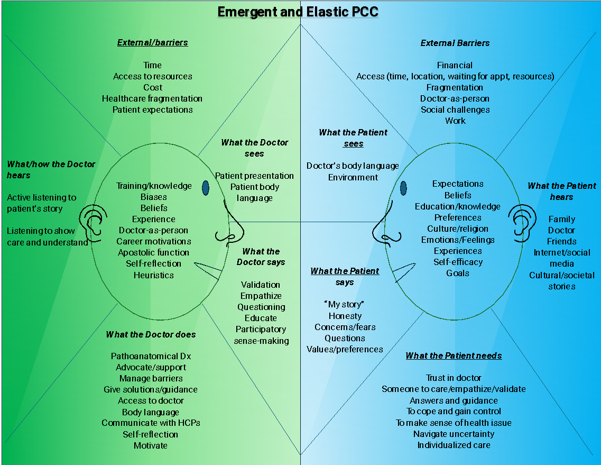
Visual thinking arts reinforce the competency to “evaluate and adapt communication strategies” by simplifying complex scientific information for diverse lay audiences—a useful tactic for researchers needing to disseminate complicated information. Figure 1 demonstrates how one of the authors (CR) modified an empathy map55 to illustrate PCC as an emergent and elastic phenomenon.6 The picture communicates, more clearly than words can, the complex relational nature of PCC, where both the patient’s and provider’s responses are dependent on the actions of each other and the environment within which they interact.
Theatre has been increasingly recognized as a powerful concrete experience41 for developing communication, empathy, and interpersonal skills in healthcare professionals. Theatre-based interventions, such as role-playing and improvisation, have been shown to enhance students’ ability to navigate complex clinical scenarios and communicate effectively with patients.56,57 By offering opportunity for reflective observation and abstract conceptualization,41 theatre directly trains the competency to “evaluate and adapt communication strategies” and “demonstrate cultural humility.”
Medical Education Empowered by Theatre (MEET)56 utilizes concepts from critical pedagogy, participatory theatre, liberation, and emancipatory education to create opportunities for students to develop capacities for empathy, presence, communication, and self-reflection, thereby becoming agents of change and social justice in clinical practice (active experimentation). MEET’s goal reflects Nicholls’ vision of a “Physiotherapy Otherwise,43 and aligns with “advocating for a health system that enhances well-being of patient, society, and the profession.”
Humanities Evoking Vulnerability
Integrating the humanities into curricula creates space for students to experience vulnerability, a fundamental part of learning.58 Learning asks us to “not know,” to sit with uncertainty and risk, and to question what we have long assumed. The humanities invite this stance, mapping directly onto the competency to “use internal and external sources of information to develop expertise that promotes adaptation to unknown or evolving situations.”
Through role-playing, reflective writing, and narrative, students encounter moments of discomfort and vulnerability that ask them to examine their biases and moral blind spots. These encounters do more than refine technique; they begin to shape the kind of clinician one becomes. As Piemonte4 notes, the humanities offer new ways of thinking about care that connect intellect with empathy, and reflection with action, which align with all stages of Kolb’s41 framework.
Molloy and Bearman58 describe ‘intellectual candor’—the practice of thinking aloud, acknowledging fallibility, and learning both for oneself and others—as essential to navigating vulnerability. This process helps socialize students into “a culture that acknowledges fallibility rather than honoring perfectionism.”58 Within such a climate, the humanities cultivate psychological safety amid uncertainty, creativity in problem-solving, and openness to change. By embracing vulnerability through these humanistic encounters, learners are better prepared for the moral and relational complexities that define PCC.
Offering Patient Enrichment
In addition to developing their humanistic qualities, the humanities can be used to help understanding and enrich patient education in clinical practice. The PT’s skillful use of storytelling and figures of speech in patient education helps the patient make sense of their situation and improve adherence.
The humanities simplify the dissemination of complex scientific information to lay audiences and patients, and can be used to persuade resistant groups.59 This supports the competency to “identify audience learning needs, considering culture and personal factors, to develop a [patient education] plan,” while also fostering the therapeutic alliance central to “implementing a person-centered plan of care.”51
Supporting Clinicians
Beyond enhancing patient care, the humanities also serve an essential role in supporting the well-being of practitioners themselves, building the competencies to “exhibit appropriate professional conduct” and “demonstrate commitment to ethical behaviour” through self-care as a professional responsibility.
Recent studies have found that 49.34% of physical therapists and 70% of PT faculty experience burnout.60,61 International data support this trend with moderate to high burnout rates among early-career PTs.62 Exposure to the humanities in the form of reflective writing and arts-based learning can offset some of the causes of burnout, offering outlets and crafting a “zone of creative relaxation”42 to address the emotional demands of the job, the lack of motivation and autonomy, boredom, and lack of support PTs may face on the job.49,57,63,64 A recent study of physician assistant students found that participation in arts and humanities modules promoted reflection and stress reduction, providing a much-needed respite from the demands of clinical training.42,54
In Kolb’s framework, the PT’s clinical encounter serves as the concrete experience, and journaling about this experience offers opportunity for reflective observation. The patterns identified from these experiences foster abstract conceptualization of professional identity and ethical behavior and problem solving, which then informs deliberate change or active experimentation in future practice. Peterson49 promotes reflective practice stating, “If physical therapists aspire toward better understanding of the human experience, they must bear witness to and interpret not only the patient’s story, but also their own.” Thus, students are provided with humanities-based skills that can sustain the competency for “continuous improvement of practice and outcomes throughout their careers.”
Barriers and Solutions to the Integration of the Humanities in PT Education
Despite the strong arguments for incorporating the humanities into PT education, significant challenges remain. The barriers to humanities integration in PT education are not independent. Rather, they form a self-reinforcing cycle that must be understood systemically. Solutions must therefore address these barriers simultaneously, not in isolation.
Curriculum Constraints
At the center lies curriculum constraints, where programs already dense with biomedical and clinical competencies are driven by accreditation and board exam requirements. Adding humanities to an already dense program risks further overburdening students.65 However, dichotomizing the humanities and sciences is unnecessary, and the humanities can be easily integrated into the PT curriculum through embedded coursework, electives, qualitative research methods, and interprofessional education, without compromising core competencies (Table 2).
Indeed, as Luna66 affirms, “although students benefit from a single teaching activity, best practice is to thread humanities instruction throughout the curriculum,” linking new knowledge of increasing complexity to the student’s prior learning in a spiral model.67
A Framework for Implementing Humanities Into Curricula
To support this, Carr et al22 created the InspirE5 framework for curriculum design and evaluation to standardize and implement the humanities into health science programs worldwide. The framework is organized around five foci detailed in Table 3. The framework identifies 11 graduate capabilities—including self-reflection, narrative appreciation, person-centeredness, and relational responsiveness—that correspond directly to CBE competencies in Communication, Patient and Client Care, and Reflective Practice.
Integration occurs without adding curricular load through two means:
- Embedding humanities within existing courses.
- Aligning humanities activities with CBE learning objectives, such as illness narratives that reflect the competency of culturally-humble communication.
Table 3: The InspireE Framework22
Focus | Description |
Environment | The institutional, political, and cultural context surrounding the program, including facilitators of and barriers to humanities integration. |
Expectations | Clearly-articulated graduate capabilities aligned with professional standards (eg, CBE competencies), embedded within core curricula rather than added as separate content. |
Experience | The learning and teaching activities designed to develop the stated graduate capabilities, such as reflective writing, narratives, role-play, arts-based learning. |
Evidence | Formative and summative assessment of humanities learning, with meaningful feedback to learners on their development of capabilities. |
Enhancement | Iterative evaluation of the program to continuously improve both student learning outcomes and faculty teaching experiences. |
PT Program Successes
Some PT programs have already demonstrated successful integration of the humanities into their curriculum. For example:
- The Humanities in Gross Anatomy Project at Des Moines University (HuGA)68 required students to create projects reflecting on their experiences with anatomical donors in the gross anatomy course, and took the form of art, poems, songs, singing, short film, journal entries, or narrative. This initiative encouraged students to engage with the humanistic aspects of their education, promoting reflective learning and enhancing their understanding of patient care.
- At another university, students conduct a memorial service to celebrate those who donate their bodies for dissection.40
- At the University of the Incarnate Word, students learning about spinal cord injuries watch the film Waterdance, the writer of which is a person with paraplegia.66 The film explores the lived experience of a person undergoing rehabilitation after spinal cord injury, and the students are required to complete reflective exercises aimed at cultivating an understanding of the feelings and perspectives of the characters.
Other forms of integration include service projects, such as pro bono clinics, which align with Kolb’s framework by providing experiential learning opportunities that help students better understand the human experience while practicing their clinical skills.37
Guest speakers with conditions that the students learn about, who share their personal stories and experiences with illness and disability is another form of integration that aligns with narrative medicine and qualitative inquiry.40
Increasing time spent on qualitative research methods is critical to humanities integration. The link between the humanities and qualitative research is rooted in their shared ontological and epistemological assumptions that knowledge is socially constructed and therefore multiple realities exist that are derived from individual experience and context. Phenomenology serves as a direct bridge to the humanities as it focuses on the deeper layers of a person’s lifeworld, just as Literature and storytelling uncover meaning underlying human experience.50
Qualitative interviewing teaches narrative competence—the ability to “acknowledge, absorb, interpret and act on the stories and plights of others.”49 Qualitative methods are the vehicle for awareness because they provide the epistemological tools required for conscientization and a path to transformative learning and moral agency. Fadiman’s book1 is the result of qualitative ethnographic methodology, and clearly illustrates the power of such approaches in transformative learning.
Competency Based Education (CBE), through competencies such as “advocates for the health needs of individuals and society” provides the structure whereby these abstract concepts are transformed into observable and assessable professional behaviors (Table 4) and can be revisited with increasing complexity in a spiral curriculum.
Table 4: Summary of the Relationship between Conscientization, Qualitative Research and CBE
Concept | Role in Education | Connection |
Conscientization | The Goal | Moving the learner to recognize the historical, cultural, and social influences of what constrains or facilitates a person’s actions, and to act against social injustice. |
Qualitative Methods | The Tool | Uncovering the lifeworld and narrative of the patient to identify injustices and understand the patient experience to facilitate good PCC and advocacy. |
Competency-Based Education | The Structure | Standardizing outcomes (like health advocacy) and assessing them through entrustable professional activities and competencies. |
Other forms of humanities integration can include elective courses that offer a more focused approach to the humanities. The Medical University of South Carolina, through interprofessional collaboration with museum educators, created an elective course that used visual thinking strategies to develop students’ communication skills.66 They applied these strategies to different pieces of art to explore perspectives on race and discrimination, as well as the lived experience of patients and gender inequity. In addition, the interprofessional approach they used trains teamwork and collaboration among healthcare providers, a fundamental skill when working as a physical therapist in any setting.
Addressing Institutional Resistance
Other barriers to the inclusion of the humanities in PT education include institutional and faculty resistance to the curriculum. Shaped by accreditation pressure, administrators may prioritize content that does not reflect the CBE competencies. In her 2007 Pauline Cerasoli Lecture titled “Sins of the Professional Programs,”69 Elizabeth Dumholdt unreservedly stated that “professional program faculty all know that they are supposed to value the liberal arts, and so they are very good, in the right venues, at saying just how much they do. What they do less well is match their policies, procedures, and actions to this platitude.”
Compounding this, faculty preparedness to integrate the humanities may be compromised. Many faculty, primarily trained in the sciences, may lack expertise in the humanities.70 In addition, there is a lack of training in diverse pedagogy to teach an increasing number of students from culturally-diverse backgrounds.33 Educators also need training and can effectively learn alongside their students through the humanities.33
Beyond the Call: Reclaiming the Soul of Physical Therapy
Healthcare is transforming. With the increasing health, social, and economic impact of chronic disease, the shifting models of healthcare, the surging diversity of patients and students in PT programs, the problems of health inequity, and the lightning-fast and depersonalizing integration of technology into clinical practice, PCC has become a clinical necessity and an ethical imperative.
To keep pace with this changing healthcare climate, a paradigm shift must occur in physical therapy education such that students emerge from DPT programs with greater cultural humility and social responsibility, empathy, and critical decision-making and communication skills.
A New, More Relevant Profession
Integration of the humanities into DPT programs can be a powerful mode of inquiry to address the physiotherapy paradox. It can not only serve to create more person-centered and socially-responsive clinicians, but also launch the profession into a new, more relevant position in this volatile era of health and social transformation, where:
- Healing is no longer measured solely in metrics, but in meaning.
- The PT is not only a mechanic of the body, but a steward of story, empathy, and presence.
In weaving the humanities into our pedagogy, we do not dilute the science. Rather, we deepen the soul of our practice and reclaim physical therapy as both art and care, science and humanity, movement and meaning.