Abstract
Background: Drumming has been utilized since early civilization as a healing modality. Music has the potential to synchronize motor patterns in the brain and contribute to cognitive functioning. Within rehabilitation, music and drumming may have important applications in assessment and treatment, particularly in facilitating upper extremity movement.
Methods: This quantitative observational content analysis combined art and behavioral coding by analyzing motor behaviors and vocalizations of individuals (N = 100) across the lifespan (aged 1 to 100 years). A film by artists Lenka Clayton and James Price was coded using Datavyu behavior coding software. Key variables included upper extremity technique (unilateral versus bilateral), grasp type, and latency from vocalization to drum strike. Data were analyzed with descriptive statistics, Pearson’s correlation, and statistical modeling.
Results: Drumming was feasible at all ages. Most individuals (53.5%) utilized a unilateral strategy and pincer grasp. For individuals who used a bilateral strategy, most (56.5%) had symmetrical hand positions. No significant correlations were observed between age and latency from vocalization to striking the drum.
Conclusion: This study supports the use of behavioral coding methodologies, which show potential to enhance the rigor of music-based motor assessment. By systematically quantifying behaviors captured in film, this approach captures behaviors in a natural setting. This study provides insight into an approach that could be used to objectively track progress in rehabilitation, support music therapy for participants of all ages, and compare behavioral trends across the lifespan.
Introduction
Background
Music represents a core aspect of humanities and is present across cultures,1 with many early civilizations recognizing music for its healing properties.2 The therapeutic mechanisms of music-based interventions, such as drumming, are well-established, and are associated with improvements in motor outcomes and cognitive function across a variety of ages and clinical settings.3 This is likely due to activation of a broad network of brain regions as a result of music engagement, contributing to increased neuroplasticity in both musicians and non-musicians, which underscores its growing role in rehabilitation.4
The Rehabilitative Value of Rhythm
The rhythmic properties of music in particular have demonstrated positive impacts on cognitive functioning and motor movement.5 Rhythmic entrainment, a process which involves coordinating a person’s movements with an external beat such as through drumming,3 has demonstrated increased synchronization of motor patterns in the brain, making rhythm-based interventions a potentially optimal therapy to incorporate into motor rehabilitation.6
Among rhythm-based interventions, drumming is a promising modality to access many regions of the brain, simultaneously engaging cognitive and motor domains. Drumming is accessible across the lifespan and can be performed as either a unilateral or bilateral task, engaging both upper extremities simultaneously.
This is particularly relevant given that many developmental disabilities affect upper extremity coordination. Bilateral tasks, like drumming, engage multiple brain regions simultaneously, including motor, premotor, cerebellar, and frontal regions,7 and are associated with increased attention and engagement, as indicated by a decreased alpha wave activity in the brain.8 Musicians in particular show increased speed and accuracy during bimanual hand movements compared to non-musicians,9 underscoring the indication to utilize bilateral rhythmic activities, such as drumming, to assess motor function.
In Practice
Music therapists, who are credentialed clinicians trained to use music-based interventions in various healthcare and educational settings, utilize drumming and rhythm-based interventions across diverse clinical settings, including for individuals with Parkinson’s disease,10,11 dementia,12 Alzheimer’s disease,13 and autism spectrum disorder.14
Benefits of music therapy drumming interventions include:
- Increased upper extremity movement and attention.15
- Increased social skill development.14
- Improvements in executive functioning.13
In addition to the benefits of music therapy intervention, music making and drumming also supports developmental goals. In infants aged 6 to 10 months, rhythmic entertainment was associated with a significant change in regulated movement patterns, suggesting that music may influence motor development.16 Similarly, in older adults with Parkinson’s disease and dementia, drumming has served as a feasible modality to target motor coordination, function, and attention.15,17 The use of drumming shows potential in assessing quantifiable progress in rehabilitation and warrants further investigation.
Beyond drumming, vocalization and instrument playing engage multiple neural networks simultaneously, including cognitive and motor circuitry, exhibiting potential for improving cognitive and motor function.18 Factors such as cognitive decline and aging contribute to differences in the timing of cognitive tasks and cues during bimanual instrument playing.19 However, the correlation between timing of vocalization during rhythmic tasks and age has not yet been studied.
Video-Based Assessment
Assessment of motor tasks through video-based, observational methods has an evidence-based history across film, sports science, and medicine, with particular relevance to research in rehabilitation.20 Nikolai Bernstein pioneered the use of video to assess motor function by developing a motion capture system to analyze movement mechanisms in blacksmiths, establishing a scientific foundation for observational analysis of movement.21
Subsequent research has emerged since then, with video recordings being utilized to assess non-verbal behavior during psychotherapy sessions,22 identify signs of obsessive compulsive disorder in pediatric patients,23 and detect early motor function markers of autism spectrum disorder and cerebral palsy.24–27 Parent-recorded home videos have also been validated for use in the General Movement Assessment.28 Baseball and soccer researchers have utilized motion capture and video analysis to evaluate game statistics and player performance.29–32 These data support the continued use of film and video as an evidence-based research modality to assess movement across many fields.
Incorporating the humanities—including art, film, music, dance, and other forms of creative expression—into rehabilitation provides unique opportunities for holistic, patient-centered care.33 These approaches can foster emotional expression, enhance cognitive functioning, increase satisfaction with therapy, and promote social interaction.34–37 Multidisciplinary approaches that consider the cultural and social dimensions of patients can further strengthen the quality of rehabilitative care.38 Drumming, in this context, represents not only a form of creative expression but also a potentially novel, accessible tool for assessing upper extremity motor functioning across the lifespan.
Despite the breadth of evidence for music’s role in motor rehabilitation and the established utility of video-based assessment, there is a critical knowledge gap in understanding the feasibility of quantitative, observational assessment of drumming as part of an artistic expression.
Study Purpose
Therefore, the purpose of this study was to quantitatively examine artistic expression from an art film and behavioral coding of motor actions and vocalizations exhibited by individuals (N = 100) across the lifespan (aged 1 to 100 years) during drumming activities. A secondary objective was to determine the feasibility of using behavioral coding methodology to assess drumming and motor patterns in individuals. To accomplish this, researchers developed a coding scheme to assess multiple motor variables during drumming, including:
- Hand grasp type.
- Strategy utilized while drumming (unilateral or bilateral).
- Symmetry of hand grasp.
- Time from vocalizing to striking the drum.
We hypothesized that behavioral coding would be a feasible, effective modality for quantitatively assessing motor movement through drumming across all ages (1 to 100).
Methods
Study Design
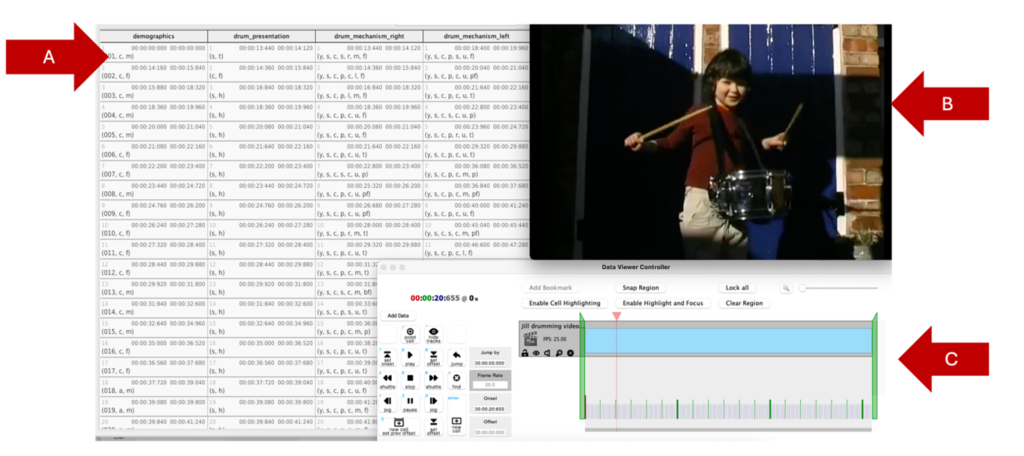
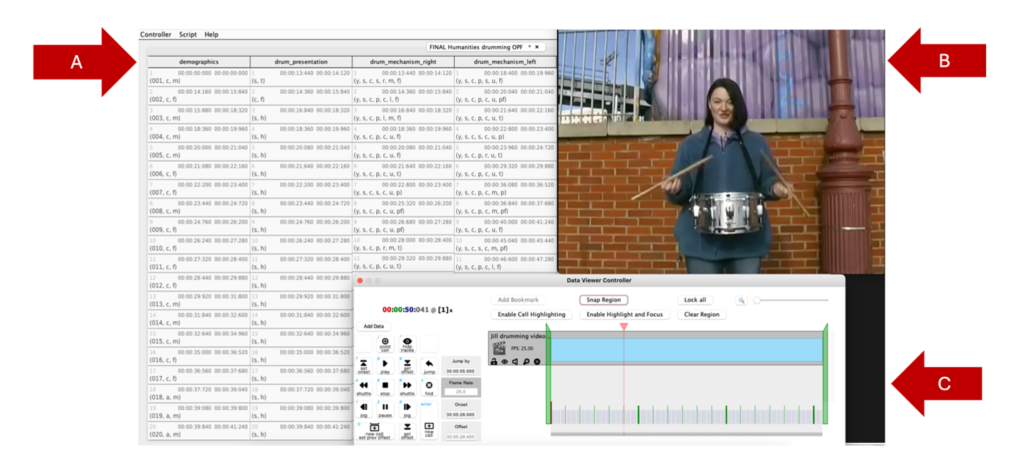
This study utilized a retrospective, quantitative observational content analysis design to describe drumming-related motor patterns in an art film of individuals across the lifespan. A film by artists Lenka Clayton and James Price featuring 100 individuals drumming, which is publicly available, served as the data source and was analyzed using Datavyu behavioral coding software (See Figure 1).39 The individuals ranged in age from 1 to 100 years. This film was chosen due to its wide range of individuals of every age, which supported the authors’ goal to understand the feasibility of quantifying upper extremity movement during drumming across the entire lifespan using film as a medium. The film was approximately three minutes in length.
Human participants in the film were coded for:
- Upper extremity technique (unilateral vs. bilateral).
- Hand grasp type.
- Latency between vocalization and first drum strike.
The study team was composed of a music therapist, physical therapist, and a kinesiologist/motor behavioralist who collaborated to develop a coding scheme of behaviors important to identify during drumming that could have implications for individuals across the lifespan in each of their respective fields.
Behavioral Coding
The researchers developed a unique custom coding scheme to quantify key variables of interest, capturing participant characteristics, positioning, and drumming behaviors. One researcher coded N=100 drummers aged 1 to 100 years. All variables were coded using Datavyu behavioral coding software, which uses frame-by-frame analysis to objectively measure motor movements. Variables were coded based on the coding scheme that was developed by the authors for this study. There was (n = 1) participant per age, and no age between 1 to 100 years was excluded from the analysis. Participant age order was recorded using a three-digit identifier, and individuals were categorized as children (< 18 years old) or adults (≥ 18 years old) (Figure 2). Demographic characteristics (gender, race, ethnicity) were not included in this analysis because these data were not available from the source material, and such attributes could not be reliably determined.
Qualitative measures coded included the:
- Position of the individual during drumming (chair/sitting, floor, standing, or lying).
- Position of the drum (table/stand, lap, strap, floor, or held by the participant).
- Grasp of a mallet or drumstick (yes/no).
- Hand position during drumming (mostly open or closed) when visible.
- Forearm position (pronation/supination) at drumming onset when visible.
- Location of initial drum contact relative to participant’s midline (center, left, right, side, or non-striking contact).
- Vertical height of the drum (upper chest, mid-chest, lower chest, pelvis).
- Grasp type when a mallet was used (eg, fist, thumb, pointer finger, between fingers) (Figure 3).
Figure 3. Variations in hand grasp utilized when holding a drumstick. 1) Fist, 2) Thumb, 3) Pointer Finger, 4) Pincer, 5) Between Finger.
| Grasp Type | Photo |
| Fist | 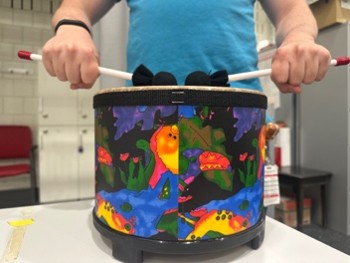 |
| Thumb | 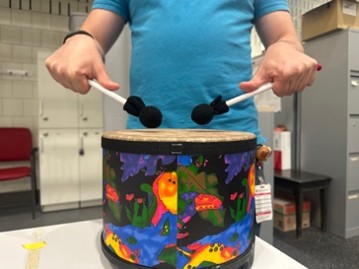 |
| Pointer Finger | 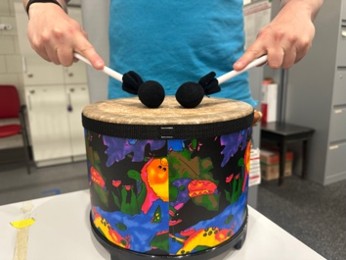 |
| Pincer |
|
| Between Finger | 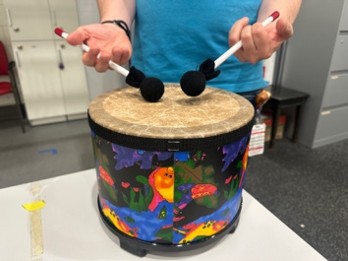 |
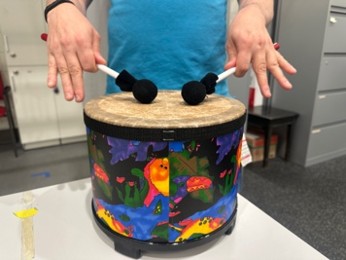
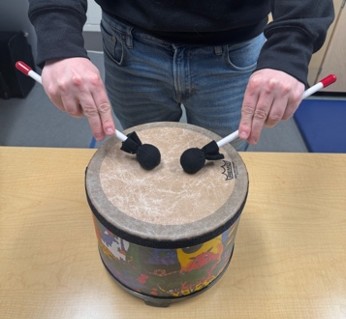
Finally, vocalization was treated as a binary variable, indicating whether an individual vocalized. Vocalization relative to drum contact (before, after, during, or none) was documented.
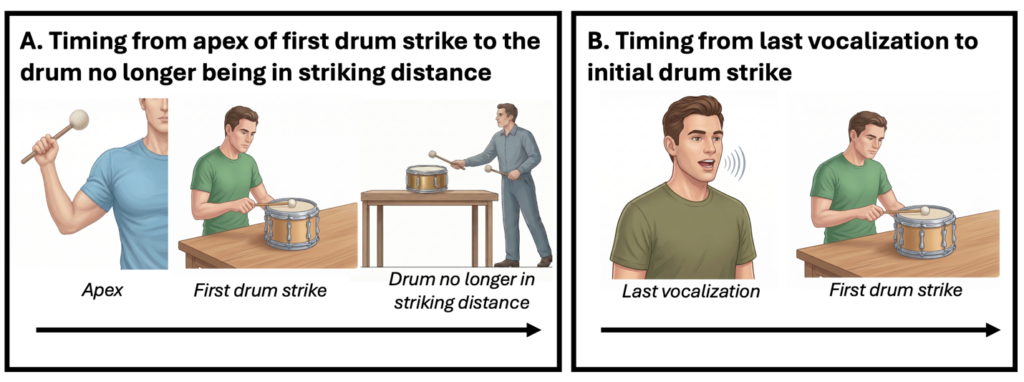
A custom MATLAB script was used to quantify unilateral and bilateral strikes by looking at the timing of the left and right strikes. When a participant struck the drum, the code identifies if both the left and right were annotated (resulting in the classification of a bilateral strike) or if only one was annotated (resulting in a classification of a unilateral strike). Continuous variables included timing in milliseconds from the apex before the participant first strikes the drum to when the drum is no longer in striking distance, and timing in milliseconds from last utterance of vocalization to the first frame the mallet or hand is striking the drum (Figure 4).
Twenty percent of the data were coded for reliability by an independent coder. See Table 1 for the complete coding scheme utilized for this study. Images in Figure 4 were generated using Illustrae (Illustrae;illustrate.co, 2026), an artificial intelligence-based scientific illustration platform. The authors provided a description of the behaviors of interest, reviewed all generated images for accuracy, and are responsible for the content of the images within the figure.
Data Analysis
Data were exported from Datavyu to MATLAB (2023b) for statistical analysis. Descriptive statistics (frequency, proportion, distribution) of drum mechanism, drumming strategy, hand position, and vocalization were calculated. We utilized percent of agreement and Cohen Kappa values to describe reliability. A Pearson’s correlation was utilized to determine if there was a relationship between age and the duration of time from vocalization to drumming, as researchers hypothesized that older age would be associated with increased time from vocalization to drum strike, which may indicate differences in cognitive ability.
To further assess this relationship, three models were fit:
- A linear regression model to assess the linear trend.
- A quadratic polynomial regression to capture potential nonlinear trends.
- An exponential model.
We utilized R squared values and the Akaike Information Criterion (AIC) to compare models. Because all models yielded similar patterns of results, the linear model was retained.
Results
Feasibility
All variables had a reliability rating between 88.8% and 100% agreement (Cohen Kappa range: 0.61-1). Behaviors were coded for 100% of drummers across the life span (individuals aged 1 to 100 years; n = 1 participant per age), demonstrating the feasibility of behavioral coding for assessing drumming across a variety of ages as well as the use of artistic video recordings for behavioral coding and analysis of movements.
All participants could be reliably coded using the researcher-developed scheme, including one individual (n = 1) who did not strike the drum. Each participant engaged in drumming to some degree, despite their age or physical ability level, demonstrating the feasibility of using drumming to assess motor movement across the lifespan. The coding scheme captured important motor variables such as grasp type, latency to drumming, and strategy (unilateral versus bilateral) used to strike the drum.
Motor Behaviors
The number of drum strikes varied by individual; the average amount of time drumming per person was 1.70 seconds. Among participants, 53.5% used a unilateral strategy (n=53); 46% used a bilateral strategy (n=46); and 1% did not strike the drum (n=1).
For unilateral strikers, 88.7% of participants struck with their right hand (n=47), while 11.3% used their left (n=6). Of the individuals who utilized a bilateral strategy, 56.5% of them had symmetrical hand positions (pronation or supination), while 43.5% of individuals had asymmetrical hand positions.
Individuals were coded for the type of hand grasp they utilized while drumming, including: 1) fist; 2) thumb; 3) pointer finger; 4) pincer; 5) between finger; or none if no mallets or drumsticks were used. See Table 2 for proportions of grasp types among participants.
Vocalization Variables
Vocalization patterns showed 43% vocalized their age prior to hitting the drum, 2% after, 4% during, and 51% did not vocalize.
Among those who vocalized, the range of latency to drum hit was 0.2 seconds to 7 seconds. When investigating if age was associated with the time from vocalization to first drum strike, Pearson’s correlation revealed that this relationship was not significant (r = 0.24, p = 0.1168) (See Figure 5). The linear regression model explained 6 percent of variance (R2 = 0.06, AIC: 622.9) in the model exploring the association between age and the timing of drumming following vocalization.
Discussion
Content analysis of an art film can objectively quantify movements and vocalization. Understanding movement patterns across the lifespan has important considerations for the field of rehabilitation. Music, due to its inherent rhythmic properties,5 provides a useful groundwork for assessing motor movement; however, quantitative assessment of this has not yet been studied.
This study fills an important gap by providing insight on the feasibility of a behavioral coding system to assess motor movement through drumming in individuals across the lifespan using a creative approach that captures individuals in a natural environment.
Results of this analysis showed behavioral coding as a feasible modality for assessing upper extremity motor movement through drumming across the lifespan.
All individuals included in this art film were able to be coded using the coding scheme developed by the researchers. This aligns with prior research exhibiting the feasibility and benefits of using behavioral coding as a means to assess motor functioning in rehabilitation settings.40–42 To the authors knowledge, this also represents the first evidence of behavioral coding as a feasible method to assess motor engagement during musical instrument playing, specifically drumming, across the lifespan. The feasibility of drumming found in this study could have application to the fields of music therapy, rehabilitation, and medicine.
Both unilateral and bilateral strategies were used with this sample. Prior research suggests that both unilateral and bilateral strategies are effective in training motor movement in upper limbs,7,43 to assess and work on motor functioning in individuals.
Most participants who utilized a bilateral strategy when drumming had symmetrical hand positions, and most individuals employed a pincer grasp (thumb and forefinger) during drumming. This aligns with prior research showing that the pincer grasp is one of the most frequently employed among adults.44
These findings further support current rehabilitation practices, as music therapists assess and consider grasp type in their standard of care. Our results provide empirical evidence that quantifying grasp type through behavioral coding may help inform goal-directed therapeutic modifications in rehabilitation.
While there were no statistically-significant correlations found between age and the time from vocalizing their age to striking the drum, a mild, non-significant, positive correlation between older age and increased time was found (r =0.24, p =0.1168). The observed correlation may reflect developmental and age-related changes across the lifespan, including noted declines in cognitive and motor function as an individual ages.45,46,47 Vocalization combined with motor tasks is associated with improved outcomes and might have applications in future research.48 These findings underscore the need for future research to consider cognitive functioning and other factors, such as age, during motor tasks such as drumming.
Study Applications
The results of this study could have important applications to the fields of rehabilitation and music therapy, as there is a growing interest in alternative approaches to assessing motor functioning across the lifespan, especially in adults.17 There is also a growing body of evidence to support assessing motor functioning in children during play, as play provides insight into movement strategies and motor planning.49,50
The ability to observe individuals in their natural environment, such as through observational analysis of videos, can retain the engagement and spontaneity of instrumental play while providing an important structure for the rhythmic and repetitive movement patterns needed for systematic motor analysis. Board-certified music therapists utilize drumming interventions to work on goals such as upper limb coordination, executive functioning, behavioral regulation, and social-emotional well-being.15,51–53
Within this context, our findings suggest that behavioral coding of drumming represents a feasible and objective modality to attain quantitative data on motor movement patterns across the lifespan. By operationalizing drumming patterns through a coding scheme such as the one created and used for this study, clinicians and researchers may be better equipped to document motor performance and share measurable patient outcomes, thus enhancing interdisciplinary collaboration across the rehabilitation space.
Limitations and Future Directions
While this study benefits from a large sample, several limitations must be considered when interpreting our results. First, the study design limits our ability to generalize findings to broader populations. The use of an artistic film for this study limited the ability to control the methodology of drumming. It was not known what cues were given to each of the individuals prior to drumming; thus it is difficult to understand the impact this may have had on their drumming mechanism and vocalizations during the drumming video. Despite the feasibility of individuals at every age (1to 100 years) being able to strike the drum, these individuals may have been selected based on their ability to strike the drum; thus, this may limit our ability to generalize the feasibility of behavioral coding across the lifespan.
Individuals were only captured drumming for a short time (3 to 5 seconds); thus, further research is needed to understand motor movement and activity across the lifespan during longer drumming sessions.
Having a limited sample of one individual per age limits our knowledge of drumming patterns within a certain age range and does not account for variability among participants in each age group. Future research is warranted to assess drumming mechanisms for a larger sample of various age groups.
Determining predictors of grasp types among individuals was beyond the scope of this study; however, future research may wish to investigate associations between predictors such as age and ability level on type of grasp used for the drum.
Conclusion
Behavioral coding of position, upper extremity movements, and vocalizations from an art film of individuals drumming was feasible across all ages, demonstrating that structured observational analysis can yield reliable data from natural, music-based activities. Such methodological approaches strengthen the rigor of music therapy and rehabilitation research by enabling objective, reproducible quantification of motor behavior. The ability to derive quantitative metrics from creative tasks such as drumming supports the feasibility of using music-based tasks as accessible tools for assessing motor and cognitive function across the lifespan.
Beyond rehabilitation, these findings underscore the broader scientific and humanistic value of artistic expression to assess human development. Drumming provides a unique framework for examining rhythm, engagement, and social communication. Such approaches may inform developmental screening, assessment, and rehabilitation in interdisciplinary fields such as music therapy, occupational and physical therapy, neuroscience, and psychology. These findings highlight the intersection of creativity and quantitative analysis to advance both assessment and humanistic inquiry, emphasizing the value of creative tasks as scalable tools for understanding human development, motor function, and engagement across diverse populations.
This study provides insight into an approach that could be used to objectively track progress in rehabilitation, support music therapy for participants of all ages, and compare behavioral trends across the lifespan. By systematically quantifying behaviors captured in film during drumming, this approach captures behaviors in a natural setting, with outcomes that can be utilized in therapeutic assessment and treatment.