Abstract
Background: Individuals with Rett syndrome often have limited access to stimulating and meaningful activities due to significant disabilities and high support needs.
Objective: This case study explores the participation of a 28-year-old woman with Rett syndrome as she engaged in assisted art tasks designed to foster meaningful interactions and rich sensory experiences. Support staff guided her through these activities during her time at a day activity center. The aim of this case study was to explore how a woman with Rett syndrome participated in and responded to an assisted art-making approach implemented at her day activity center.
Methods: Qualitative data were collected through photographs, open-ended evaluation forms, and interviews with support staff and the participant’s mother. The data were analyzed using inductive content analysis.
Results: The findings suggest that the art tasks—characterized by joint participation, task adaptations, and scaffolding strategies—promoted sensory engagement, communication, and social interaction. The woman was consistently reported to enjoy the activities.
Conclusion: This case study demonstrates that assisted art-making activities can be enjoyable for individuals with Rett syndrome and may provide opportunities for development and learning.
Keywords: Art therapy, communication, intervention, occupational therapy, Rett syndrome
Introduction
Rett syndrome is a rare neurodevelopmental disorder that predominantly affects females (approximately 1 in 9,000 to 10,000) and is characterized by impairments in cognition, motor function, and communication.1,2 Following the characteristic regression in speech and language development, communication abilities may continue to develop across the lifespan, although trajectories vary.3 Individuals with Rett syndrome typically rely on multiple communication modalities, most commonly eye gaze, alongside body movements, and augmentative and alternative communication (AAC) systems such as symbol boards and eye-gaze technologies.
Communicative development has been associated with responsive partner strategies and scaffolding approaches, including aided AAC modeling, where spoken language is paired with pointing to graphic symbols.4 Motor impairments are another core feature of Rett syndrome. Hand stereotypies, loss of functional hand use, and impaired gait form part of the diagnostic criteria,5 resulting in a need for substantial lifelong support in everyday activities.6
Individuals with Rett syndrome have the same rights as others to participate in meaningful activities that support development, well-being, and quality of life, including equal opportunities for inclusion and participation in community and cultural life as specified in the UN Convention on the Rights of Persons with Disabilities.7 Within occupational therapy (OT), meaningful activities are those that are personally relevant and engaging for the individual, provide opportunities for participation and choice, and contribute to a sense of purpose, enjoyment, or well-being.8,9
Because individuals with Rett syndrome often have limited opportunities to influence or actively engage in everyday activities, creating opportunities for participation in meaningful activities is particularly important. OT interventions may support such participation through individualized, activity-based approaches. Creative activities such as arts and crafts are commonly used in rehabilitation contexts and can engage both cognitive and motor processes while remaining adaptable to individual needs.8-10 Art therapy (AT) similarly emphasizes the therapeutic value of the creative process and the potential of art-making as a means of expression.11,12
Integrating OT, AT Principles to Engage Clients
In this article, we explore how principles from OT and AT can be integrated, reflecting their shared emphasis on engaging clients in meaningful activities. These approaches may be particularly beneficial for individuals with cognitive and communication disabilities, as they provide alternative, non-verbal means of communication and engagement.13,14 Clinical guidelines highlight the importance of client choice, collaboration, playfulness, and communication support in such interventions.15 Empirical studies suggest that AT can enhance communication and social interaction among adults with developmental disabilities.16
Emerging digital tools may also facilitate creative participation. For example, the Painteraction system enables individuals with severe disabilities to create drawings while receiving visual feedback on a screen as they move their bodies.17 Despite increasing interest in this area, research on art-based interventions for individuals with Rett syndrome remains limited.18
Assisted Art Projects
Although adults with Rett syndrome are often familiar with photographs and symbolic images used in AAC systems,3 severe limitations in hand function may restrict their ability to manipulate artistic materials.19 Consequently, substantial support and adapted tools are often required. In Sweden, day activity centers provide opportunities for participation in structured activities, including creative work. With appropriate support, adults with Rett syndrome may engage in artistic processes that promote exploration, enjoyment, and personal development.20
In this case study, an art correspondence course titled Let’s stART was implemented to enable a young woman with Rett syndrome to participate in assisted art activities at her day activity center. The course was developed by the first author, an art and occupational therapist, and was informed by theories emphasizing the value of creative activity for engagement, skill development, and personal growth.6,9,11 The course was designed to promote shared participation, sensory exploration, creative expression, and choice rather than artistic outcomes. These features are consistent with OT perspectives on meaningful activity, which emphasize engagement in personally-relevant experiences.8,9 The aim of this case study was to explore how a woman with Rett syndrome participated in and responded to an assisted art-making approach implemented at her day activity center, from the perspectives of several stakeholders involved in the experience.
The Chosen Case and Participant
A qualitative case study design was chosen to enable an in-depth exploration of how one woman with Rett syndrome participated in and responded to an assisted art-making intervention in her everyday context. The case was defined as the implementation of the intervention with one adult woman with Rett syndrome within her usual day activity center. The participant was selected purposively because her combination of severe motor and communication impairments and regular participation in a day activity center provided an appropriate opportunity to explore how individualized support could facilitate participation in assisted art activities. The case was therefore bounded by 1 participant, 1 day activity center, the Let’s stART intervention, and the 9-month implementation period, allowing an in-depth exploration of how tailored adaptations and staff support influenced participation in assisted art activities.
The participant had previously demonstrated enjoyment of activities involving colors and shapes, which were used to assess her cognitive and perceptual abilities, and had engaged actively in these activities during a previous assessment in which the first author participated. In addition, support staff reported that painting was already a familiar part of her day program, where she used an adapted paintbrush to paint labels. These observations informed the development of the Let’s stART intervention, with activities designed to build on the participant’s demonstrated interest in painting while extending opportunities for creative expression within her everyday environments.
The participant, referred to by the pseudonym “Liz,” is a woman in her 30s with classic Rett syndrome and a confirmed MECP2 gene mutation.21 She has severe intellectual disability and epilepsy. Liz is non-verbal and communicates primarily through eye gaze and body movements.
She demonstrates clear interest in social interaction, particularly when communication partners use AAC systems such as the Pragmatic Organization Dynamic Display (PODD) book. Although she does not consistently clearly confirm or reject messages, she expresses interest or disinterest through eye contact, gaze direction, and subtle body movements. Dyspraxia, seizures, fluctuating health, and varying levels of attention influence her participation and performance in activities.
Liz’s gait is classified as non-functional; she walks only during assisted therapeutic sessions, corresponding to Level III (Therapeutic Ambulators) on the Modified Hoffer Ambulation Scale.22 Her gross motor abilities are assessed as severely affected according to the Rett Syndrome Motor Evaluation Scale.23
Fine motor abilities were evaluated using the Rett Syndrome Hand Function Scale.24 Consistent with Level 5 on the scale, she can grasp, pick up, and hold at least 1 large object for a minimum of 2 seconds, and use a raking grasp to pick up and hold a small object for the same duration. She predominantly uses her left hand in assisted activities. Liz’s arm movements are limited, and she frequently requires assistance to reach or grasp tools. In contrast, her eye-gaze control is well-developed.
Liz lives in her own apartment with support staff available around the clock. She attends a day activity center 5 days a week, where she participates in individually-adapted activities, including listening to music, watching films, socializing with peers, swimming, drama, textile printing, and outdoor activities such as visits to the beach. Painting labels with an adapted paintbrush is also part of her regular program. All activities are supported by staff. She reportedly dislikes noisy environments and prolonged periods of sitting without meaningful engagement.
Materials and Methods
Intervention
An art correspondence course titled Let’s stART (www.nationelltcenter.se) was employed to provide Liz with new opportunities to engage in art activities. The course consisted of 5 course letters, each containing 5 structured art tasks, for a total of 25 tasks. Completion of the course required performing at least 1 task from each letter.
Inspired by common preschool art exercises, the tasks were adapted for adults by the first author. They were designed to facilitate playful and accessible exploration of art materials within a shared activity,25 allowing participation regardless of prior art experience, disability, or hand function. The course emphasized interaction and shared experience rather than the participant’s ability to independently complete the tasks. The tasks were also designed to encourage close interaction between participants, offering opportunities to engage with sensory impressions and movement.26
Procedure
Descriptions of the art tasks, together with an evaluation form for each task, were sent to Liz by post. The evaluation form included 3 open-ended questions addressing any adaptations made to the activity, experiences of the shared activity, and additional reflections. Liz’s mother and support staff were asked to select at least 1 task from each set of mailed task descriptions and to first explore the task themselves to assess whether additional adaptations were needed based on Liz’s abilities. The first author remained available via email or telephone to address any questions during the course.
Materials recommended for the tasks were provided by Liz’s day activity center. After exploring and carrying out the selected art activities with Liz, the support staff who attended each task completed the corresponding evaluation forms based on their observations of Liz’s participation and communication, and provided photographic documentation of the art-making process. They then requested the next set of art tasks. A total of 7 support staff participated during the course, with 1 staff member at a time participating in the art tasks with Liz.
They worked with Liz daily and were familiar with her individual communication patterns, including her use of eye gaze, facial expressions, body movements, and behavioral responses. Their assessments of Liz’s engagement and affect were therefore based on their established knowledge of her typical communicative repertoire rather than on isolated observations during the intervention. The course progressed as support staff completed the selected activities and requested the subsequent set of art tasks.
The course was implemented over a nine-month period at Liz’s day activity center. Upon completion of the course, follow-up telephone interviews were conducted with Liz’s support staff and her mother to explore their perceptions of the feasibility of the art correspondence course in Liz’s daily life. The interview questions were developed by the first author and focused on the respondents’ experiences of implementing and supporting the art activities, perceived facilitators and barriers, adaptations made to enable Liz’s participation, and their observations of Liz’s engagement and responses during the activities. The interviews were conducted by the first author and lasted between 15 to 20 minutes.
Data Collection and Analysis
The qualitative data comprised written responses in the evaluation forms, interview transcripts, and photographs documenting the art-making process. An inductive content analysis was conducted following established qualitative procedures.27,28 First, all data were read repeatedly to obtain an overall understanding of the material. Meaning units relevant to the study aim were then identified, condensed, and assigned descriptive codes. The codes were developed inductively from observable behaviors and descriptions documented in the evaluation forms, interview transcripts, and photographs.
For example, repeated descriptions of sustained attention, active eye-pointing to select colors or materials, initiation of movements toward the activity, smiling, laughter, and continued participation despite physical effort were coded as indicators of engagement, whereas descriptions of looking away, reduced attention, or withdrawal were coded as reduced engagement. Codes reflecting similar content were then compared and grouped into broader categories, which were subsequently abstracted into the 3 final categories presented in the Table:
- Adaptations and prerequisites.
- Scaffolding strategies.
- Engagement and interest.
The first author conducted the initial coding and categorization of all qualitative data. To enhance the credibility of the analysis, an experienced colleague independently reviewed the coding structure, category development, and interpretation of the material. Differences in interpretation were discussed until consensus was reached. To enhance reflexivity, the first author also considered how prior experience in OT, AT, and the development of the intervention might influence data interpretation throughout the analytical process. The coding structure and category development were therefore independently reviewed by a second researcher, and differences in interpretation were discussed until consensus was reached to ensure that the findings remained grounded in the data.
Ethical Approval and Considerations
Ethical approval was obtained from the regional ethical review board (EPM dnr 2017/44-31, 2025-02200-02). Written informed consent for participation and publication was obtained from Liz’s parent, who is also her legal guardian. Verbal consent was obtained from the manager of the day activity center and from all involved support staff.
As Liz did not communicate at a symbolic level and lacked a consistent method for responding to questions involving abstract concepts, it was determined that she could not provide informed consent herself, necessitating specific ethical considerations. The art tasks were selected based on Liz’s interests as reported by her immediate social network, with the intention of offering new and varied artistic experiences.
Liz’s parents and support staff were informed that participation in the correspondence course could be discontinued at any time. In addition, support staff were instructed to closely monitor and interpret Liz’s responses and to modify the activities accordingly. Her assent was therefore inferred from her participation in the activities and from the support staff’s careful interpretation of her reactions.
Results
Five course letters were received, and 10 art tasks were completed. Seven different support staff assisted Liz throughout the course and observed how she responded to each task. For 7 of the art tasks, Liz was supported by 2 staff members; for the remaining tasks, she was supported by 1. A total of 77 photographs documenting the art-making process were received.
The qualitative content analysis resulted in 3 main categories, presented in the Table below.
- First, adaptations and prerequisites for Liz’s participation are described, including the use of modified art materials, adapted furniture, and communication aids.
- Second, the scaffolding strategies employed by the support staff are outlined.
- Third, Liz’s responses—specifically signs of interest and engagement—during the art activities are summarized.
Table. Examples of codes and categories derived from the inductive content analysis of evaluation forms, follow-up interviews with Liz’s support staff and mother, and photographic documentation of the art-making process.
| Category | Examples of codes | Illustrative examples from the data |
| Adaptations and prerequisites | Adapting materials and tools; adapting the physical environment; using communication aids; enabling choice | Tools attached with tape or placed on anti-slip surfaces; adapted scissors; wooden frames; tiltable table; use of PODD; opportunities to select colors through eye gaze |
| Scaffolding strategies | Providing physical assistance; adjusting the level of support; experimenting with strategies to facilitate participation; facilitating and interpreting communication | Support to hold and manipulate materials; hand-under-hand support; assistance with standing; trying different tools and materials; staff interpreting and responding to Liz’s communicative signals |
| Engagement and interest | Sustained attention; expressing preferences; showing enjoyment; active participation; variable engagement | Following activities with her gaze; eye-pointing to select colors or materials; smiling and laughter; initiating movements toward the activity; continued participation despite physical effort; looking away or reduced attention |
Participation may be expressed through engagement and interest, which are elaborated upon in the third category. In the following sections, Liz’s engagement and interest in the art tasks are presented in relation to adaptations and scaffolding strategies, illustrating how such support enabled her participation.
Adaptations and Prerequisites
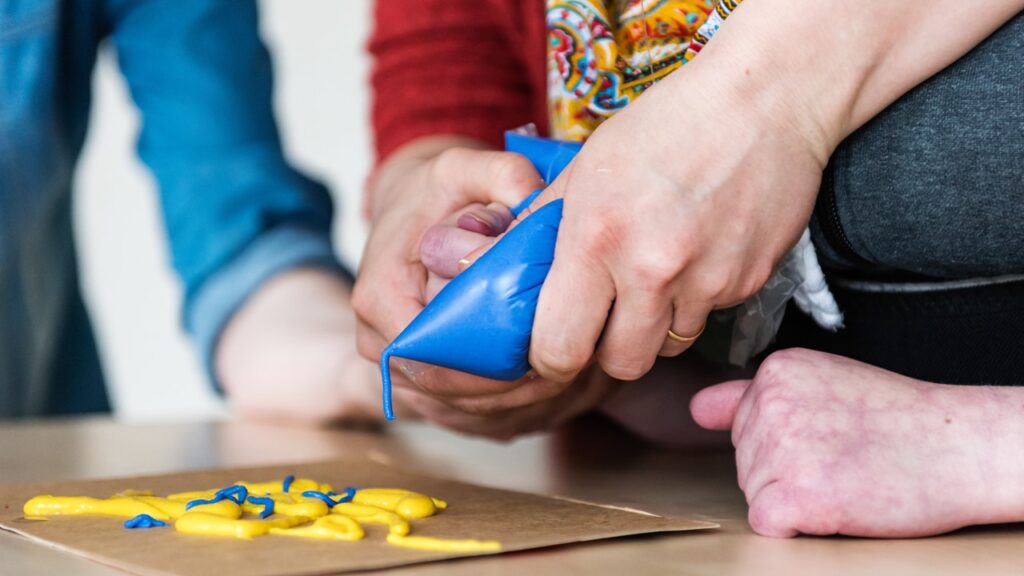
In Letter 2, the Puffy Painting task was introduced, using a plastic bag, a sheet of paper, brushes of various sizes, and paint. Liz participated while seated in a work chair at a tiltable table (i.e., a table that could be adjusted to different angles), which helped her maintain focus. She used her usual left-arm movement pattern, painting on the left side of the paper.
Support staff reported that she was highly motivated and demonstrated strong intent when selecting colors through eye-pointing (i.e., looking at the color she preferred). Support staff interpreted Liz as enjoying the tactile experience of handling the plastic bag filled with puffy paint (a mixture of flour, salt, color pigment and water) and was able to squeeze out the paint independently. Despite her limited arm reach, Liz painted with her left hand by moving her arm in sweeping motions from the center of her body. She also used the brushes in a similar manner. Liz was described as eager to participate.
In the Picasso Collage task (Letter 2), Liz used her left hand, with right-side support, to cut images using adapted scissors fixed to a table with an anti-slip surface. Support staff described Liz as engaged while cutting out pictures of lips, eyes, and ears from magazines. Many collage pieces were collected, and Liz was reported to enjoy the cutting process. She also contributed by drawing lines beneath the collage with a black marker, with guidance. Support staff held and guided the paper while assisting her; she occasionally managed to press the scissor blade herself but typically required hand-under-hand assistance. While she could select and cut images with help, arranging the collage pieces independently was challenging and required support.
In the Miró Game task (Letter 4)—a prefabricated game featuring various Miró-inspired figures associated with dice numbers—the importance of Liz’s communication aid, the Pragmatic Organization Dynamic Display (PODD) book, was demonstrated. Positioned on the table, the PODD book was used throughout the session. With support, Liz threw the dice, and the corresponding figure was drawn by the support staff. Liz selected marker colors through eye-pointing. Seated in a supportive work chair and assisted from both sides, the support staff used the PODD book to interpret and confirm Liz’s reactions and preferences.29 Support staff described Liz as enjoying the activity and showing consistent interest and engagement.
Scaffolding Strategies
In the Sugar Painting task (Letter 1), Liz was assisted from her right side to use her dominant left hand. She employed a modified lateral grip with extended fingers and a cylindrical power grip during the activity. According to support staff, Liz showed no visible reaction to the colorless sugar water, but her facial expression brightened when colored paint was dripped or pressed onto the sugar surface.
Support staff provided opportunities for Liz to select colors through eye-pointing, which she did. They also experimented with both a paintbrush and an adapted sponge attached to a stick to identify ways for Liz to best participate. Simply releasing the sponge onto the paper proved effective. Due to muscle tension, she required substantial assistance, and hand-under-hand support was reported to be particularly helpful. Support staff observed that Liz appeared to enjoy the activity and seemed to be in a very positive mood.
In the Printing Ink task (Letter 4), Liz was given the opportunity to select colors and newspapers, which she was assisted in wrinkling and pressing into blobs of paint. During the activity, support staff found through experimentation that using a paper plate was more effective than the originally intended sheet of paper. Support staff described Liz as enjoying the task while engaging with the visual, tactile, and auditory stimuli it provided. She used her left hand with a modified lateral grip, supported from her left side by the support staff. The PODD book was consistently used throughout the session to support communication.
In the Mix and Paint Colours task (Letter 5), Liz was manually supported to stand while painting and used her left hand with a modified lateral grip to hold a small sponge, assisted from her left side. At other times, she sat down and selected colors through eye-pointing. The fluid paints were poured into a plastic folder pocket, sealed, and taped to a window for visual effect. Support staff reported that Liz showed limited interest during the task itself but enjoyed observing the final result. The PODD book was also used throughout the task to support communication.
Engagement and Interest
Support staff reported that some art tasks engaged Liz more strongly than others. In the Paint with the Hand task (Letter 1), Liz was seated in her wheelchair and assisted from her right side to use her non-dominant right hand. The paper was taped to the table, and she was supported in using her right index finger, knuckle, and palm to paint and print. Support staff reported that Liz followed the entire process with her gaze, and interpreted her as being satisfied. They also described her as enjoying selecting colors through eye-pointing and that Liz appeared to enjoy being the focus of the shared activity. No major adaptations were required apart from support related to her stiff, flexed fingers.
In the Ball Painting task (Letter 1), a wooden tray containing a sheet of paper, paint, and balls was used to create a drawing. Support staff observed that Liz followed the preparation attentively, and described her as appearing expectant. The tray was adapted with a homemade wooden frame, and she was assisted in moving it in different directions. Although support staff reported that Liz had enjoyed the earlier tasks, they described this activity as the one she enjoyed the most. She looked very happy, remained highly focused for an extended period, and stopped only when she suddenly became fatigued, at which point the session ended.
Another engaging activity was the Land Art task (Letter 3). During an outdoor walk, while being pushed in her wheelchair, Liz collected natural materials such as leaves, berries, and pinecones. Upon returning indoors, she was seated in a supportive work chair at a table and, with right-side assistance, used both hands to explore the gathered materials. Support staff described Liz as showing interest in the sensory aspects of the activity by engaging with the materials through touch, smell, taste, and sight. She actively participated in the creative process by selecting and manipulating objects with either hand and arranging them on the paper according to her own preferences.
In summary, photographs and reports from support staff illustrate how Liz maintained focus and used eye gaze effectively during the art activities, shifting attention between support staff, her communication aid, and the art materials. This suggests that her engagement was manifested as enjoyment in shared, focused attention. The photographs also provided insight into how tasks were adapted to accommodate her needs. Depending on the thickness of the tools, Liz was able to slightly adjust her left-hand grip.
She completed 8 of the 10 art tasks seated in a work chair at a round table in a spacious room, wearing an apron, with support staff seated alternately on her left and right sides. On one occasion she performed a task while standing, and on another she participated outdoors while using a wheelchair. The figure below presents examples of the Puffy Painting Task and the Land Art Task, both of which are included in the Let’s stART intervention. The individuals depicted are not participants in the present study, to protect participant confidentiality.
Figure. Photographs from the Puffy Painting task (left) and the Land Art task (right), both of which are art tasks included in the Let’s stART intervention.

Feasibility of the Intervention
Regarding barriers, support staff reported limited time to familiarize themselves with the art tasks before introducing them to Liz. However, they noted that the art course provided Liz with new and varied experiences, including diverse sensory stimulation and opportunities to make choices and influence the activities. Support staff reported that Liz was particularly engaged when selecting colors.
The art tasks also facilitated more active use of Liz’s AAC system (PODD), which appeared to encourage staff to allow more time for her responses. Additionally, discussing the visible results with Liz—both immediately after and later—was considered beneficial. The visual works created during the art tasks remained available for later viewing and discussion—an opportunity that, according to the support staff, Liz particularly appreciated. One support staff member noted:
“She gets affirmation. Previously she was quite agitated, but now she is not, thanks to the PODD. For example, we used the PODD book to say, ‘We are going to create something.’ During some of the messy art tasks, we remained on the ‘creative’ page in the PODD book, which helped clarify the process for her. It is much clearer when we explain and share what has been done.”
Support staff also highlighted that Liz’s health influenced her participation; on good days she was actively engaged, while after seizures she mainly observed the activities. Although Liz was already familiar with joint activities and using AAC, the correspondence course was described as health-promoting and a source of new ideas and inspiration for both Liz and her support staff.
Discussion
This study described the participation and responses of a woman with Rett syndrome, Liz, during assisted art activities at a day activity center. Participation in cultural activities contributes to meaningful leisure and quality of life, yet individuals with significant disabilities often have limited access to enriching arts experiences.30,32
Within OT, meaningful activities are those that are personally relevant and engaging for the individual, provide opportunities for participation and choice, and contribute to a sense of purpose, enjoyment, or well-being.8,9 In the present case, Liz was reported to be highly engaged in most activities, and support staff noted that the course provided new ideas for creating accessible and engaging situations. A novel feature of the case study was that principles from OT and AT were integrated with the aim of providing activities that are personally relevant and engaging for the participant, and thus meaningful.
The art correspondence course offered varied sensory experiences and opportunities for Liz to make choices—for example, when selecting colors. Opportunities for control and decision-making are often limited for individuals with Rett syndrome, making such experiences particularly meaningful. These findings align with previous research indicating that creative activities can promote participation and learning among individuals with extensive disabilities.15,30
Participation in the art tasks was facilitated through individualized adaptations and supportive strategies. Modified materials, adapted furniture, and staff scaffolding—including physical assistance and hand-under-hand support—enabled Liz to manipulate tools and materials despite motor limitations. The use of the PODD communication system also supported interpretation of her reactions and preferences during the activities.
The art tasks appeared to encourage greater use of the PODD symbol system, increasing staff attentiveness to Liz’s responses and providing more opportunities for choice and engagement. This finding is consistent with research suggesting that art-based activities can facilitate communication and interaction.30 Support staff also reported that Liz enjoyed observing the visual outcomes of her work and discussing them afterwards. Similar processes have been described in AT, where observing and reflecting on artistic outcomes can support communication and meaning-making.13
The activities may also have provided opportunities for learning. During the sessions, Liz observed support staff modeling symbol-based communication through the PODD system. Symbolic understanding develops gradually through multiple stages before reaching full pictorial representation.31 Long-term engagement in creative activities combined with graphic AAC tools may therefore support image creation, symbol interpretation, and communicative development.32 Further research is needed to explore these possibilities.
Methodological Considerations, Limitations, and Future Directions
A key strength of this study is the detailed description of how art activities were individually adapted for Liz. However, as this is a single case study, further examples and more rigorous research designs are required before broader conclusions can be drawn about facilitating participation in art activities for individuals with Rett syndrome. The use of multiple qualitative data sources (evaluation forms, interviews, and photographs) enabled triangulation of the findings and strengthened the credibility of the analysis. The inclusion of video recordings could have provided richer data by capturing Liz’s actions and responses in greater detail and supporting triangulation of staff observations.
Interpretations of Liz’s engagement were based on support staff who knew her well and routinely interpreted her individual communication signals. Nevertheless, these interpretations remain subjective, and future studies could strengthen trustworthiness by using structured observation protocols, observer training, video recordings, or independent coding of behavioral cues.
Time constraints also influenced implementation for staff. Ideally, staff would have familiarized themselves with the materials and tasks beforehand, but this was difficult due to existing routines and staff turnover at the day activity center. In addition, only 1 task from each of the final 2 course letters was completed. Nevertheless, staff were able to allocate sufficient time for Liz to participate in the course.
Given the staff’s limited prior experience with art-making, ongoing support from the first author may have enabled further task adaptation. To address practical constraints in day activity centers, the course could potentially be introduced through online workshops that also provide opportunities for continued guidance and support.
Practical Implications
Art activities for individuals with Rett syndrome require individualized adaptations and supportive strategies.6 In this study, Liz’s engagement appeared to be supported by the attentiveness of support staff and their use of scaffolding communication strategies. The use of the PODD communication system may also have increased staff responsiveness to Liz’s communicative signals and supported her engagement through aided communication input.
Given the limited access to meaningful arts and leisure activities for individuals with extensive support needs,30,32 this case provides a practical example of how participation in creative activities can be facilitated for a person with Rett syndrome. Strengthening collaboration between art therapists, occupational therapists, and support staff may help expand opportunities for stimulating and meaningful activities in day activity centers and similar settings.
Conclusion
This case study illustrates how tailored adaptations and supportive strategies in art activities can create opportunities for sensory engagement, communication, interaction, participation, and learning for individuals with Rett syndrome. To support the implementation of such activities in day activity centers and other environments where individuals with extensive support needs spend their everyday lives, dedicated time for staff training and professional dialogue is essential. Further research is needed in this area, and this case study may serve as a starting point for exploring the largely underexamined field of art-based interventions for individuals with Rett syndrome.