Abstract
Introduction. The occupational therapy (OT) profession in recent years has been grappling with the ongoing impacts of colonialism and its implications for education and clinical practice. This includes challenging the centering of Western ideologies and science, and continuing reproduction of Western dominance in rehabilitation. Highlighting colonial harms such as land displacement and Residential Schools, we aim to connect historical and ongoing colonial practices to global patterns of oppression. Despite ongoing challenges, the importance of emphasizing Indigenous resilience and cultural reclamation is vital to illuminating the importance of Indigenous knowledges and Peoples to the profession.
Objectives: This manuscript features personal narratives from Indigenous and non-Indigenous occupational therapists in Canada, sharing our experiences and perspectives on reconciliation between Indigenous Peoples and settler society. We explore what reconciliation means specifically for the field of OT, highlighting the impacts of colonization on Indigenous individuals and communities. Through the sharing of our own stories, we provide learnings on how occupational therapists can, and must, contribute to reconciliation efforts, including the need for systemic changes, embracing Indigenous knowledges, and fostering respectful relationships.
Conclusion: The work underscores the importance of understanding historical and ongoing colonialism to promote healing and uphold Indigenous rights within the profession. Although there is importance in enacting change at the individual level, change must also occur at broader systemic and institutional levels to meaningfully and sustainably move toward reconciliation and decolonization. This work is required not only in the Canadian context but other countries with similar colonial histories.
Notes to Readers:
- The authors use the term ‘Indigenous’ throughout this manuscript and wish to acknowledge the limitations and implications of collapsing diverse Indigenous Nations and Peoples under one umbrella term. Indigenous Peoples in Canada have had many shared experiences and also many that are specific to territory and People. We speak about specific Peoples wherever possible.
- We also acknowledge the complexity and politics surrounding use of the term ‘settler’. In our understanding, this term is not only a label that directly connects identity to colonialism, but also requires a commitment to resist the status quo, which we may not always meaningfully enact.1
- In terms of our positionalities as authors of this article, we are a woman with mixed Mi’kmaw and settler ancestry, a man with mixed Métis and settler ancestry, and two white women of settler descent.
Introduction
In this manuscript, we employ storytelling to share our experiences and learnings about the status of reconciliation between Indigenous Peoples and settler society in the territory of Turtle Island now known as Canada (readers interested in learning more about the origins, history, and usage of the term “Turtle Island” can visit: https://www.thecanadianencyclopedia.ca/en/article/turtle-island). As two Indigenous and two non-Indigenous occupational therapists, we focus specifically on what we’ve learned reconciliation means for occupational therapy (OT). Although we cannot claim to represent the perspectives and experiences of all Indigenous Peoples on Turtle Island, we are humbled and grateful to share our stories, and we hope the reader can glean relevant learnings from our narratives. For this opportunity, we say thank you in three Indigenous languages: wela’lin (Mi’kmaq), maarsii (Michif), and qujannamiik (Inuktitut).
Indigenous Nations Across Canada
The territory presently known as Canada is home to a large number of Indigenous Nations who have lived and thrived on the land since time immemorial. The diversity of Indigenous Nations and Peoples across Canada is evident in thousands of distinct languages, customs, and relationships to the land. However, common threads among all Indigenous Peoples on Turtle Island are experiences of colonization and cultural genocide enacted by Western governments since the first arrival of European settlers centuries ago. Some of these colonial actions include displacement of Indigenous communities from their traditional land, imposition of violent Western forms of governance, and the theft and forced removal of Indigenous children from their families to be placed into foster care or church- or state-operated Residential Schools that forbade the practice of Indigenous cultures.2
A History of Colonial Oppression
We also note that settler colonial violence enacted upon Indigenous Peoples in Canada both reflects and is connected to the oppression of colonized Peoples in other parts of the world (eg, similarities between the South African apartheid system and Canadian laws regarding Indigenous Peoples3).
As a result of continued colonialism and systemic anti-Indigenous racism in various sectors such as healthcare, education, governance, etc., many Indigenous individuals have been disconnected from their culture, lands, and communities—and many communities experience significant health disparities.2 Indigenous health disparities are in large part due to Canada’s colonial history and inequitable access to and distribution of resources.4-6
The Residential School System and Canada’s deleterious Indigenous policies therein stand as one of the most compelling examples of the impact of colonialism on the overall health of Indigenous Peoples,7 with Indigenous scholars such as Charlotte Reading describing colonialism itself as a social determinant of health for Indigenous Peoples.8 Indigenous lives are further negatively impacted by systemic and interpersonal racism, including in health and social services, leading to a lack trust in public institutions.4,9 However, beautiful stories of resistance, resilience, and cultural reclamation are found throughout Indigenous communities, including among the narratives in this manuscript.
The OT Profession and Indigenous Peoples
The OT profession is complicit in these harms and has been critiqued for its colonial underpinnings. OT theories and practice models based on Western ideologies have been highlighted as a source of conflict when working with Indigenous Peoples.10-16 In an article newly published in the Journal of Occupational Science, Pride17 asks that we move beyond literature in the occupational science and therapy disciplines to deeply consider how the work of Indigenous scholars in Indigenous health, history, geography, and other disciplines can support reconciliation efforts in OT.
Moving Toward Reconciliation
In recent years, the historical and ongoing colonization of Indigenous Peoples and its continuing harms are finally coming to light through inquiries such as the Truth and Reconciliation Commission of Canada2 and the inquiry into Missing and Murdered Indigenous Women, Girls, and Two-Spirit Peoples18 as prominent examples. Both inquiries illuminate the ongoing systemic discrimination, racism, harms—but also call on Canada to move toward a goal of reconciliation.
Enacting reconciliation within the Canadian context is a multifaceted endeavour,19 encompassing strategies such as increased self-determination among Indigenous governments, the return of stolen land to Indigenous Nations, and bringing public awareness to the full stories of atrocities such as the Residential School System. Yet, the term reconciliation itself is critiqued for being largely ambiguous without a shared common understanding of how best to enact it.19 Nonetheless, striving toward this reconciliation also requires effort at all levels of Canadian society, including within individual professions such as OT.14
The work required involves decolonization – described as the need to dismantle colonial systems and decrease the power they currently hold20 in favour of creating new and dynamic systems.21 At the same time, decolonizing work must involve supporting systems grounded in Indigenous ways of knowing and according them space and power to thrive.22 We must listen to the concerns of Eve Tuck and K. Wayne Yang around decolonization as process slipping into metaphor23 – which requires continual engagement in both dialogue and critiques of process.
Three Stories
Utilizing a storytelling approach, three of us (Turner, Pride, and MacLachlan) offer stories below, while the fourth author (Lizon) supported the vision of bringing these stories together to contribute to dialogue regarding reconciliation, Indigenous knowledges, and occupational therapy. All four of us believe in the power of collaborative storytelling and we hope our stories from diverse regions of Canada (Figure 1) as Indigenous and Indigenous-allied individuals offer the reader lessons in how occupational therapists can work toward reconciliation while understanding the challenges and areas of action for all in OT. If you are unfamiliar with the Canadian context, we believe our stories can impart wisdom that is applicable to international efforts at decolonizing the OT profession.
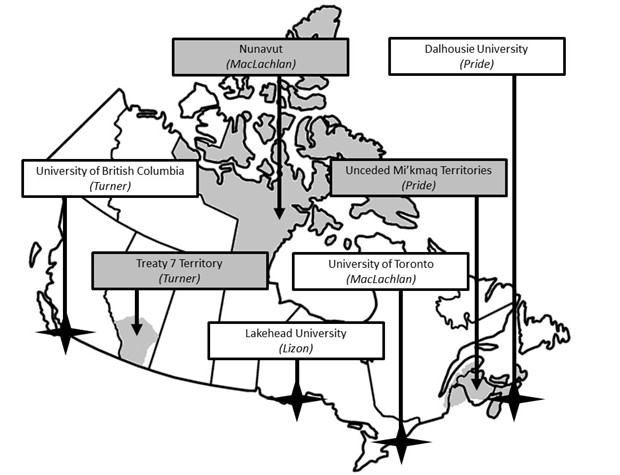
Note. The map is not to scale; the elements shown on the map are approximated to their true location/region. Four-point stars indicate the universities at which this manuscript’s authors were studying at the time of writing: University of British Columbia, Lakehead University, University of Toronto, and Dalhousie University. The geographic regions that the co-authors discuss in their narratives are shaded in gray (Treaty 7 Territory[1], Nunavut, and Unceded Mi’kmaq Territories). Universities and geographic regions are named in rectangular boxes, each including their corresponding authors’ last name written in italics. This figure includes an adapted image licensed
[1]With respect to the term “Treaty 7 Territory”, the government of Canada signed eleven numbered treaties with various First Nations from 1871-1921. Each treaty encompasses a different geographical area and includes a list of agreements between Canada and the signatory First Nations regarding land ownership, resource extraction, and provision of funding and services by the federal government to Indigenous communities. The territory of Treaty 7 is located in southern Alberta. Readers interested in learning more about the numbered treaties (including critical perspectives) can find additional information at https://www.thecanadianencyclopedia.ca/en/article/numbered-treaties.
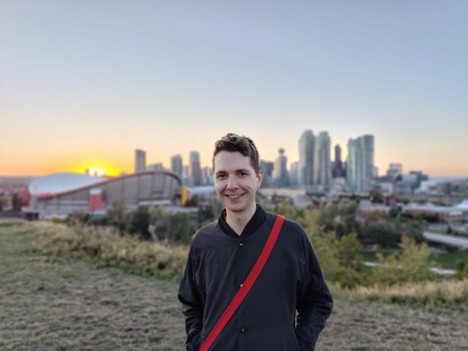
Justin’s Story
Click on the image to read Justin’s story.

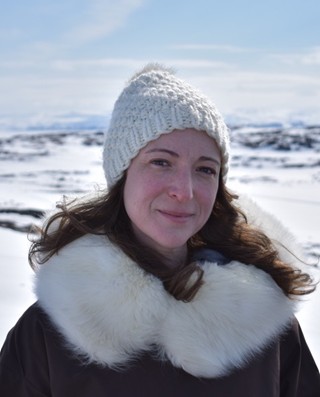
Tara’s Story
Click on the image to read Tara’s story.

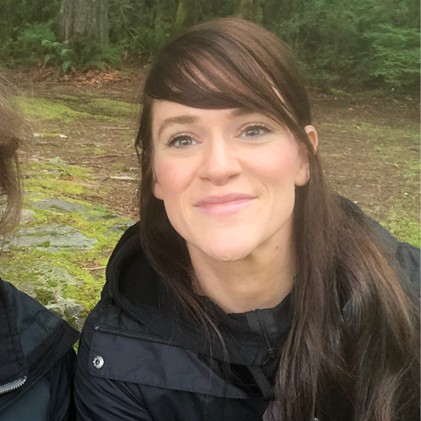
Janna’s Story
Click on the image to read Janna’s story.

Conclusion
A common thread throughout each of the stories presented is how colonization led to a disruption of where we stand. For Justin, it was physical land. For Tara, it was identity. For Janna, it was navigating her role as a settler. Reconciliation is, in part, a search for a more solid collective footing. This footing must be one that benefits everyone in Canada, requiring significant work to uphold Indigenous rights and support healing from colonial harms.
OT actions to resist the impact of colonial forces on occupation can’t happen solely at the level of individual intervention between a therapist and Indigenous person receiving services. To truly respond to national and international documents like the TRC Calls to Action2 and the United Nations Declaration on the Rights of Indigenous Peoples,35 changes must primarily happen at systems, political, and institutional levels.
This large-scale change is necessary to:
- Improve university curricula.
- Make space and validation for non-Western means of assessment and intervention.
- Resist the apprehension and destruction of Indigenous lands.
- Protect and affirm Indigenous rights.
- Ensure that Indigenous occupational therapists can be themselves in their workplaces, so that the OT community can provide a welcoming environment to more Indigenous occupational therapists.
We invite readers of this work to reflect on our stories and draw from them lessons that are relevant to the work they currently engage in. We feel as though this is one of the key purposes for weaving both stories and critical thoughts together in this work—to avoid attempts to guide readers on exactly ‘what’ to do, but instead to invite critical reflection based on context and experience. This work won’t always be comfortable, it won’t be easy, but we can do it with empathy, humility, love, and respect in our hearts.