

My name is Justin Turner and I am an occupational therapist and recent PhD graduate in Rehabilitation Sciences from the University of British Columbia (UBC), whose main campus is located on the traditional, unceded territory of the xwməθkwəy̓əm (Musqueam) People. Although I am grateful for the opportunity to live and learn on these lands that feature endless Pacific Ocean waves, towering coastal mountains, and ancient cedar trees, I am originally from a different region of Canada (southern Alberta) that is far from the ocean and falls within the (overlapping) traditional territories of several First Nations and the Indigenous Nation to which I belong: the Métis Nation.
The part of southern Alberta where I was born and raised is part of a larger region today called the Canadian Prairies. This area is marked by a flowing landscape of grassy hills, vast riverways, and limitless sky. The land has given me an open-hearted perspective on life and new experiences, which I carry with me wherever I go. I wonder sometimes whether my ancestors who lived on the Prairies felt the same about this land (Figure 2).
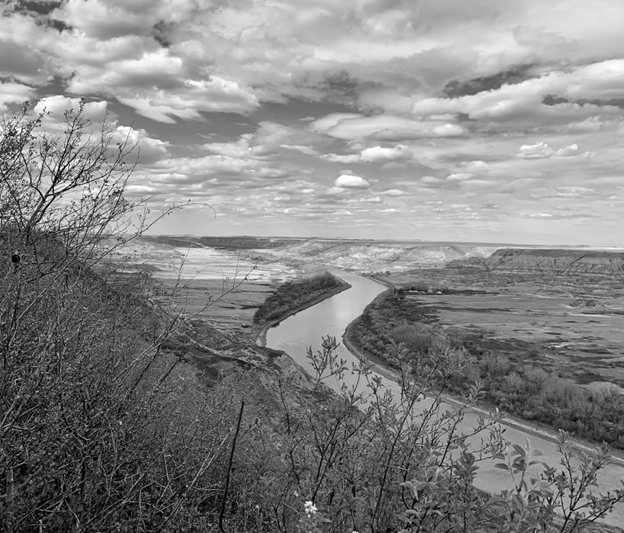
Note. Photo captured by Justin Turner on May 17, 2020 in Kneehill County, Alberta overlooking the Red Deer River valley from Orkney Viewpoint. The top half of the image shows an afternoon sky with many Cumulus mediocris clouds. In the lower half of the image, the Red Deer River is shown winding its way through a two-kilometres-wide valley that varies from 80-150 metres in depth. Several distinct sedimentary layers can be seen on the hilly sides of the valley. The land at the bottom of the valley is mostly covered in grass, with some shrubs and deciduous trees located near the river.
In addition to the region’s natural beauty, the Canadian Prairies have a complex and multicultural history—which I see reflected in my own family tree. On my dad’s side of the family, I am descended from European settlers who built farmsteads in western Canada during the 19th century on lands that were coercively taken from Indigenous Nations by colonial governments. In particular, the land where my paternal ancestors settled was located within the traditional territory of my Métis maternal ancestors (the Homeland of the Métis), which overlaps with the territories of other Indigenous Nations such as the Anishinaabe, Blackfoot, Cree, and Sioux Peoples.
For readers who are unfamiliar with the Métis Nation, some of our cultural practices include the Red River Jig dance, engagement in hunting, fishing, and berry-picking, and a distinct style of beading called flower beadwork—from which the Métis are sometimes nicknamed the Flower Beadwork People. Other names for our people include Otipemisiwak (meaning “the people who rule themselves” in Cree) and âpihtawikosisân (meaning “half-son” in Cree). The Métis People constitute one of the largest Indigenous Nations in Canada and I am proud to be a Métis Nation citizen.
As a reader, you might ask: why is Justin sharing all these details about his family history in a manuscript about OT and reconciliation in Canada? My short answer would be that I agree with Indigenous scholars such as Dwayne Donald,24 who position stories and relationships as fundamental in repairing social fractures caused by forces like colonialism. By hearing another person’s life story or learning about another culture, we help to build greater empathy in our world.
I think this fact is intuitive for most occupational therapists, since our work involves listening to all kinds of people’s stories, reflecting upon how their lives are impacted by personal and environmental challenges, and problem-solving how to help them achieve specific functional goals despite those challenges. With that perspective in mind, I want to share a story about my mother that relates to Indigenous reconciliation.
I have many early memories of being on the land with my mom, such as looking for dinosaur fossils in the hilly and cactus-covered terrain of the Prairies, driving past miles of purple flax and yellow canola fields to visit one of my aunties, or swimming in a muddy lake on a hot summer day. As an adult, all of these memories are precious to me and stand out in my mind like brightly-coloured flowers. I think my favourite childhood recollections of my mom, though, involve picking lii pwayr (“saskatoon berries” in Michif) with her by the Red Deer River.
She had grown up by the river and, over the years, found locations where the saskatoon bushes would be absolutely weighed down with the delicious purple fruit—which is an important cultural and nutritional plant for Indigenous communities across Western Canada, including the Métis People. When she took me and my brother berry picking, we always brought several empty ice cream pails which we would fill to the brim and have to effortfully carry back to the car. By the time we drove home, all of our hands and faces would be stained dark purple, partially from the act of picking the berries and partially from shoveling dozens of them into our mouths. Once home, we would freeze most of the pails, give a few to friends and neighbours, and use some fresh saskatoons to make pies, muffins, and jelly.
When I became a young adult and moved away from home to attend OT school at UBC, I found myself missing the slightly sour and mildly sweet taste of the saskatoon. I was living in Vancouver at the time and asked at a local farmer’s market whether they sold the berry, but was met with a quizzical stare from the merchant. I decided that, when I was back in southern Alberta next berry season, I would get my mom to take me to a saskatoon bush spot by the river. Unfortunately, I never got that chance. After a two-year battle with a rare type of cancer called embryonal rhabdomyosarcoma, my mother passed away in March 2017.
Over the course of her illness, my mom fought her cancer as hard as she could, accessing every available evidence-based treatment and listening diligently to her oncological team. I was able to attend some health appointments with her, meeting many lovely medical professionals along the way. Health workers who stand out in my mind include a creative physiotherapist who helped my mom walk again after her cancer treatment necessitated a leg amputation and a palliative care nurse who had a kind demeanour and wonderful sense of humour.
In addition to the experiences of receiving dignified healthcare, I also witnessed my mom face racism from the health system for being Indigenous. In one instance, I waited with her for several hours in the emergency department while she was in excruciating pain after the admitting nurse—who seemed to buy into racist stereotypes—implied my mom had a substance use disorder and was faking her symptom severity in order to obtain unneeded prescription painkillers. Unfortunately, stories like this are common among Indigenous people trying to receive help from healthcare providers.
Now that I am a healthcare worker myself, I often think of the negative experiences my mom faced during her cancer journey and endeavour to be an advocate for people whose identities are marginalized by society. I try to emulate the staff who created positive experiences for my mom and our whole family, which involves avoiding assumptions about those I am caring for and enacting therapeutic use of self to develop better relationships. I also center my practice in principles of trauma-informed care (TIC), which is an approach to working with individuals who have survived “singular or cumulative experiences that result in adverse effects on functioning.”25(p1) TIC emphasizes respect for diversity, offering autonomy and choice, transparency about organizational policies and care plans, a “belief that recovery is possible for all,”25(p2) and other actions related to fostering a safe relationship between service providers and service users.
Outside my OT work, my mom influences my life in countless ways. She was a beautiful Métis woman with a friendly smile, a warm personality, and a love of dancing. I feel connected to her whenever I hike somewhere with hilly terrain, swim in a natural body of water, or go for walks by the river—though now as a university student in Vancouver it is by the Fraser River in BC where I can most often be found rather than at wâwâskêsiw-sîpiy (Cree word for the Red Deer River and its connected waterways).
During spring and summer 2020, I found myself living back home in southern Alberta for a few months as the COVID-19 pandemic forced my PhD studies to go entirely online. While there, I went searching for my mom’s favourite berry-picking spot. Surprisingly, I found the location from memory, as though its coordinates were ingrained somewhere within me.
When I got there, however, the area was blocked off by a petroleum company with a big “no trespassing” sign posted on the fence. I also looked down toward the river from the fence and saw the spot with the bushes was gone, with a gravel parking lot now covering the land. I felt a horrible sad feeling that my beloved berry bush—the spot my mom had shown me and that she had perhaps learned about from another family member—now ceased to exist.
After I recovered a bit from the initial shock of the berry bush being destroyed, I reflected on how this experience and many more traumatic losses are so common among Indigenous individuals in Canada and worldwide. Dispossessed of our lands and barred from engaging in our cultural practices, all Indigenous Peoples have faced loss of occupation due to ongoing settler colonialism.26. Over generations, these losses create a compounded grief that Indigenous Peoples carry in everyday life.
Those who possess power and privilege, including healthcare professionals like occupational therapists, must learn about Indigenous Peoples’ histories and cultures in order to enact reconciliation. They must practice in a trauma-informed manner. They must advocate with Indigenous individuals who are accessing the healthcare system, as well as for the rights of Indigenous Peoples at large. By reading my story in this article—as well as those of my friends Tara and Janna that follow—I hope the reader will draw some inspiration to work toward decolonization and reconciliation.

This work is licensed under a Creative Commons Attribution 4.0 International License.