

Kwe. Taluisi Tara Pride, I am Mi’kmaw and a member of Sipekne’katik First Nation on my father’s side, and of European ancestry on my mother’s side. I have spent my entire life exploring and residing in Mi’kma’ki—the unceded territories of the Mi’kmaq. Mi’kma’ki encompasses the easternmost parts of the land now called Canada, as well as part of the American state of Maine. I have fond childhood memories, surrounded by family and friends, of exploring this beautiful land that I’ve called home.
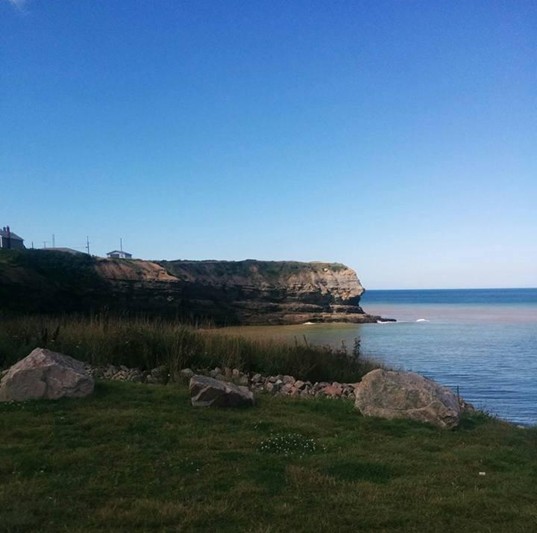
Note: Photo captured by Tara Pride on August 29th, 2015 at the tip of Glace Bay on Cape Breton Island (Unama’ki), Nova Scotia (NS), while spending a few weeks with family and friends. The changes to these cliffs over the past 20 years are astounding. When I was a child, you could explore the beaches and extensive cliffs around the area. Now, much of the area is blocked off or deemed unsafe due to severe erosion, including many houses. This region that I grew up knowing and thoroughly enjoying has been slowly slipping away into the ocean.
In my early life, I was not provided the opportunity to engage with Mi’kmaq culture and ways of being for reasons related to colonialism. My father was placed into foster care in the 1960s—removed from his family, and placed with a white family in Glace Bay, Cape Breton. His story is not unique for many Indigenous children in Canada, and represents an example of the Sixties Scoop and the consequences of colonial policies. The Sixties Scoop saw the deliberate removal of Indigenous children from their families to assimilate them into European culture. His foster care experience was never spoken about in his household growing up, but I do know that my grandmother gave him everything she could. He grew up in an environment that was loving, family oriented, and kind.
In my father’s adult years, his interest in his biological family grew. He found out over a four- or five-year search that he was a citizen of the Mi’kmaq Nation and had many biological siblings. He searched for as many siblings as he could find to connect with. I consider these series of events as major turning points in the trajectory of my own life, as I proceeded to undertake my own journey in exploring my Mi’kmaw identity, the community I am a member of, and my family connections.
It was through this quest for knowledge, for family, and for understanding, that we uncovered more than we could have imagined. Some information I wish I had known earlier; some I wish I had never learned of at all. It took over 15 years to find out that my father had a sibling who lived 10 minutes away from where he grew up; the records were sealed. All of these years; the time wasted; this reality is one many Indigenous families have experienced due to decades of ongoing colonialism and colonial control.
I start off this narrative work with a personal account as it provides a glimpse of who I am, and why I see things in the way I do. It represents my worldview and understandings of the world. As Indigenous scholar Margaret Kovach says:
“We know what we know from where we stand”27(p7)
Without knowing where I stand, my context, or my experiences, how I view the world would lack important context. Teachings I’ve received have shown me that context is incredibly important in Indigenous cultures; I hope my own context is interwoven throughout this narrative. What will follow is my story—one that embodies a search for purpose while simultaneously experiencing an identity crisis. Who am I? Though still present in my consciousness, these questions have become clearer over the years. I write this from my perspective as (first and foremost) a Mi’kmaw woman reclaiming identity, but also as a wife, a daughter, a sister, a niece, a cousin, an occupational therapist, and an academic.
Throughout my time at secondary school, I experienced a deep internal conflict. At school I often heard racism and hate expressed toward those who come from equity-deserving groups. Meanwhile, I had witnessed many instances in which my father experienced discrimination and racism simply for the way he looked. For me, this experience was different. Although I am Mi’kmaw, I did not experience overt discrimination due to the way that I looked. I had (and still have) white passing privilege. My skin tone was light enough that I was able to choose who I disclosed this information to, and when. My safety was somewhat guarded; resulting in me feeling as though I was living in two worlds. This experience is ongoing for me—and deeply impacted, and continues to impact, the way I engage in a variety of occupations.
My undergraduate and graduate school experiences were influential, but also incredibly challenging. I completed my undergraduate degree in psychology from Dalhousie University and, immediately afterwards, went on to study OT at the same school. This career choice was exciting; I had always wanted to work in some area of healthcare, and OT appeared at first glance to align well with what I envisioned helping people to be. It moved away from a strictly medical model toward understanding the complexities of human experience.
I saw similarities between OT and Indigenous ways of knowing, being, and doing, such as a holistic view of health, the importance of community wellbeing, and notions of relationality and relational accountability. This sentiment is shared by other Indigenous occupational therapists who choose to enter the profession.15
During my OT training, I learned how to be a ‘good’ practitioner, how to treat and support individuals, and how to (still working on this one) describe OT. But the tension I thought would resolve itself deep within me was still there—ever present. Given its origins, the OT profession is grounded on and derived from Western ways of knowing and seeing the world.10-16
Therefore, I am left to wonder how as Indigenous people we stay true to our own ways of knowing, being, and seeing the world while simultaneously taking up education that privileges, values, and draws mainly from Western ways of seeing and being in the world? This question is one I’ve come to learn is ever-present in the minds of many Indigenous students and healthcare practitioners, and one that has guided my work ever since.
I did a lot of work throughout my OT training, and subsequently in my doctoral work, reconciling this question. I began to actively identify areas of OT practice that didn’t quite sit well with what I knew and what I’ve experienced as a Mi’kmaw person. This thinking was timely, as the TRC had just completed years of work and published their findings, which included 94 Calls to Action for Canadian society to enact reconciliation.28 I did research and began talking to whomever I could.
I found a mentor at the OT school who accepted, valued, and encouraged my challenges and questioning of the Western underpinnings of OT and the impacts on this for Indigenous Peoples and communities. At the same time, I started a position as the Regional Coordinator of the Atlantic Indigenous Mentorship Network. In that position, I collaborated with Indigenous graduate students, academics, community members, and allied Indigenous health scholars to better support Indigenous learners in post-secondary spaces. These experiences have led me to where I am today—working as an educator and researcher to identify ways to support Indigenous-led programming and research.
A few key points can be gleaned from this story:
- The field of OT currently is not necessarily a safe space for Indigenous learners and clinicians.15,17,29
- Yet, we know that Indigenous Peoples have so much to contribute—as evidenced by the wealth of Indigenous scholarship emerging in health, geography, social sciences, engineering, and many other areas.
- The OT profession does a disservice to all learners and clinicians when we only draw from and privilege Western ideologies and worldviews.
- Finally, we do not yet fully understand the occupational impacts of Indigenous learners and clinicians who come into OT and don’t feel welcomed or as if they belong; this is something the OT profession must urgently address if we are to advance toward reconciliation.
I wish to connect these experiences and key points to the guiding principle of Etuaptmumk (Two-Eyed Seeing). Etuaptmumk (loosely translated to the gift of multiple perspectives) is a guiding principle conceptualized first in the Atlantic region by Mi’kmaw Elders Drs. Albert and Murdena Marshall, and Dr. Cheryl Bartlett.
Etuaptmumk recognizes that if society wishes to begin addressing the major crises we are currently facing—health, social, or environmental—there is a need to move beyond simply considering Western ways of knowing and knowledge systems as the sole holders of relevant information.30 There is a need to utilize Western and Indigenous ways of knowing (among others as well) to meaningfully address the challenges we face.30 Importantly, this concept is place-based, and other Indigenous Nations and communities likely have differing terms that describe similar understandings.
Theoretically, this sounds rather straightforward; practically, Etuaptmumk has proven to be of great importance, but also of great complexity to put into action, given that colonization and colonialism continue to dominate society through systems of oppression, privilege, and power. Etuaptmumk requires recognition of the value of multiple perspectives—meaning settlers have an obligation to appreciate, value, and support Indigenous knowledges and Indigenous sovereignties. At this time, I’m not sure this is something mainstream society is entirely, truly, and meaningfully ready to embrace; however, engaging in dialogue is an important first step.
Linking this to my identity and (re)connecting to Mi’kmaq culture, Etuaptmumk has helped me understand that my identity doesn’t need to be an ‘either-or.’ I believe this guiding principle and its teachings offer a lot to the profession of OT, as well, which has not meaningfully engaged with how to embody a process that values epistemological pluralism and other ways of being and doing.
Although Two-Eyed Seeing is mentioned in the Canadian Association of Occupational Therapy Indigenous Health practice document,31 we have work to do in order to embody this guiding principle. We have a strong, growing community of both Indigenous and non-Indigenous OT professionals who work within institutions, in hospitals, and in communities—all places where meaningful change can, and needs to, occur.
Throughout my work, one of the resounding statements I’ve heard regarding what OT can do is simply to listen and take guidance from those who know their people and their communities best. If we are truly and meaningfully able to do this as a first step, we could radically transform our profession. This allows for a more nuanced and pluralistic understanding of the world, which inevitably supports diverse populations we aim to serve.
OT has a long way to go to enact reconciliation with Indigenous Peoples—and radical change is needed. When I say we need to meaningfully incorporate Indigenous ways of knowing, being, and doing, I don’t mean we should simply add Indigenous content into our curriculum and profession and stop there. Métis scholar Adam Gaudry and Danielle Lorenz critique this action as mere ‘Indigenous inclusion.’32 The addition of Indigenous content into and across OT curricula is an important preliminary step, but it should not be the end.
There is a dire need to move beyond preliminary actions toward a curriculum (and more broadly, a university) system that embeds Indigenous knowledge systems into every facet of programming. We are not there yet, and it will take many years, but this is how I envision our profession showing leadership toward advancing reconciliation and enacting the 94 Calls to Action.28
This work is licensed under a Creative Commons Attribution 4.0 International License.