

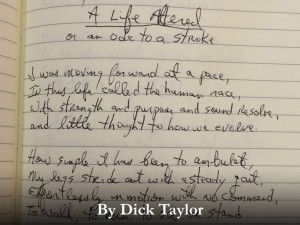
Poem: Ode to a Stroke, or A Life Altered
It is important to explore the valuable information from patient poems and a potent example of this insight is evident in Mr. Dick Taylor’s poignant reflection on his experience of suffering a stroke. Certainly no standardized outcome measure could reveal the depths of his emotions like the words of his poem, which allow us an intimate view into his true struggles.
Introduction to the Journal of Humanities in Rehabilitation
For the inaugural issue of the Journal of Humanities in Rehabilition, Dr. Sarah Blanton reflects on the mission and vision of JHR while detailing the articles featured in this inaugural issue.
Invitation from the Humanities: Learning from Voices Outside of Sciences
Dr. Ruth Purtilo shares her endorsement of the timely and critical role of a humanities journal effectively propels us forward with a sense of confidence in our purpose. Dr. Purtilo, with her wise and long-held leadership in physical therapy, so eloquently notes: “[s]pringing from our beginnings of ‘setting rehab goals’ for the other, what has sprouted is the realization that our success ultimately depends on engaging a deeply human involvement with the other” and the humanities provide guidance to cultivate that connection.
Embodied Narrative: Living Out Our Lives
For this inaugural issue, we are very humbled and honored to have Dr. Rita Charon share her perspectives on the importance of humanities in rehabilitation sciences. Dr. Charon, who has pioneered the study of narrative medicine, generously provides an interdisciplinary perspective that powerfully underscores the concept that humanities are “[f]ull partners in the restoration of health.”
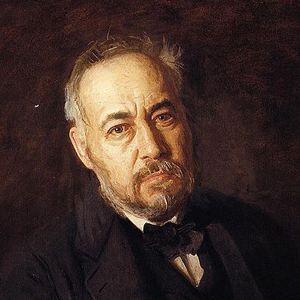
The Anatomy Studies of Thomas Eakins
The Historical Perspectives in Art section provides an introduction to a classic artist (painter, sculpture or photographer) whose work may reflect a study of human body and movement, confrontation with disease or other aspects of the human condition. For our first example, we chose one of the most influential artists in American history, Thomas Eakins. A realist painter, photographer, sculptor and fine arts educator, he is known for his in-depth study of the body in motion.
Reflections on Writing Patient Poets: Illness from Inside Out
Dr. Marilyn McEntyre further expands on the impact of poetry for patients in her book, “Patient Poets: Illness from the Inside Out.” She gently encourages us to explore the valuable information we can learn from patient poems not gleaned from our typical clinical evaluation.

Perspective: Lessons Learned on Teaching Narrative
Download the article (pdf) Table of Contents For the past several years, we have been teaching physical therapist students at Emory University to write narratives
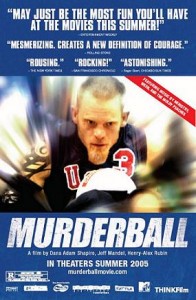
Murderball — Beyond the Documentary
Katherine Voorhorst’s media review of Murderball, including a special interview with the film’s director, gives us a sense of the film’s impact on the public’s awareness of wheelchair sports and provides insights into the use of the film as a tool for teaching.
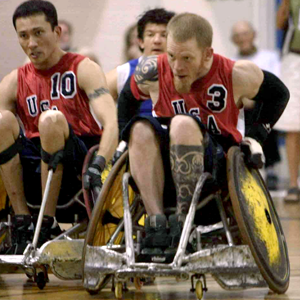
Murderball — A Metaphor for Recovery
In this expansion to the media review of the film, Murderball, Dr. Sarah Caston builds upon the films theme to share an intimate and deep reflection on her experiences with this patient population and her own personal evolution in this challenging area of practice.
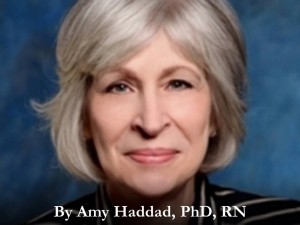
Poem: At Rehab
The power of poetry surfaces from several authors’ perspectives. Dr. Amy Haddad, currently the President-Elect for the American Society for Bioethics and Humanities and a published poet, shares her poem “At Rehab.” Her words and her reflection remind us of the door poetry opens to truly understanding others.
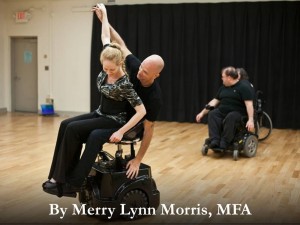
Mobilizing Possibilities: Dance, Disability and Technology
Merry Lynn Morris, MFA provides an inspiring example of this restorative role of humanities in the performing arts as she describes her journey in the development of the innovative Rolling Dance/Mobility Chair project.
Enough Said
In this thoughtful narrative reflection, Dr. Keenan Whitesides recounts a patient interaction where she learned how to lead with humanism and that “sometimes the best instruction comes from knowing when to say nothing at all.”
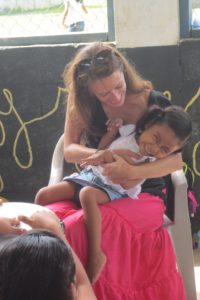
Context is Everything
In this powerful narrative reflection, Dr. Rebecca Gene Crockett details her experience working abroad as a clinician and using a humanistic lens to better understand the importance of addressing societal barriers than impact clinical care.

More than the Sum of his Symptoms
In this thoughtful narrative reflection, Dr. Allison Nogi recounts an early patient interaction as a student in which she learned the importance of treating patients with compassion.